HIST 223 Medieval Europe: History Illuminated

Historical artifacts from the Middle Ages. Vivid, colorful, and illuminating the past. Here we analyze objects, artifacts, monuments, relics, and material culture as a response to the numerous myths that circulate 'fake news' about the Middle Ages--from their belief in the flat earth (fake!) to the female lock-n-key chastity belts (fake!). In addition, this site will highlight medieval films in all their attempted history (for better or worse). Let's get medieval.

Its Raining Roses, Hallelujah

St. Elizabeth, princess of Hungary


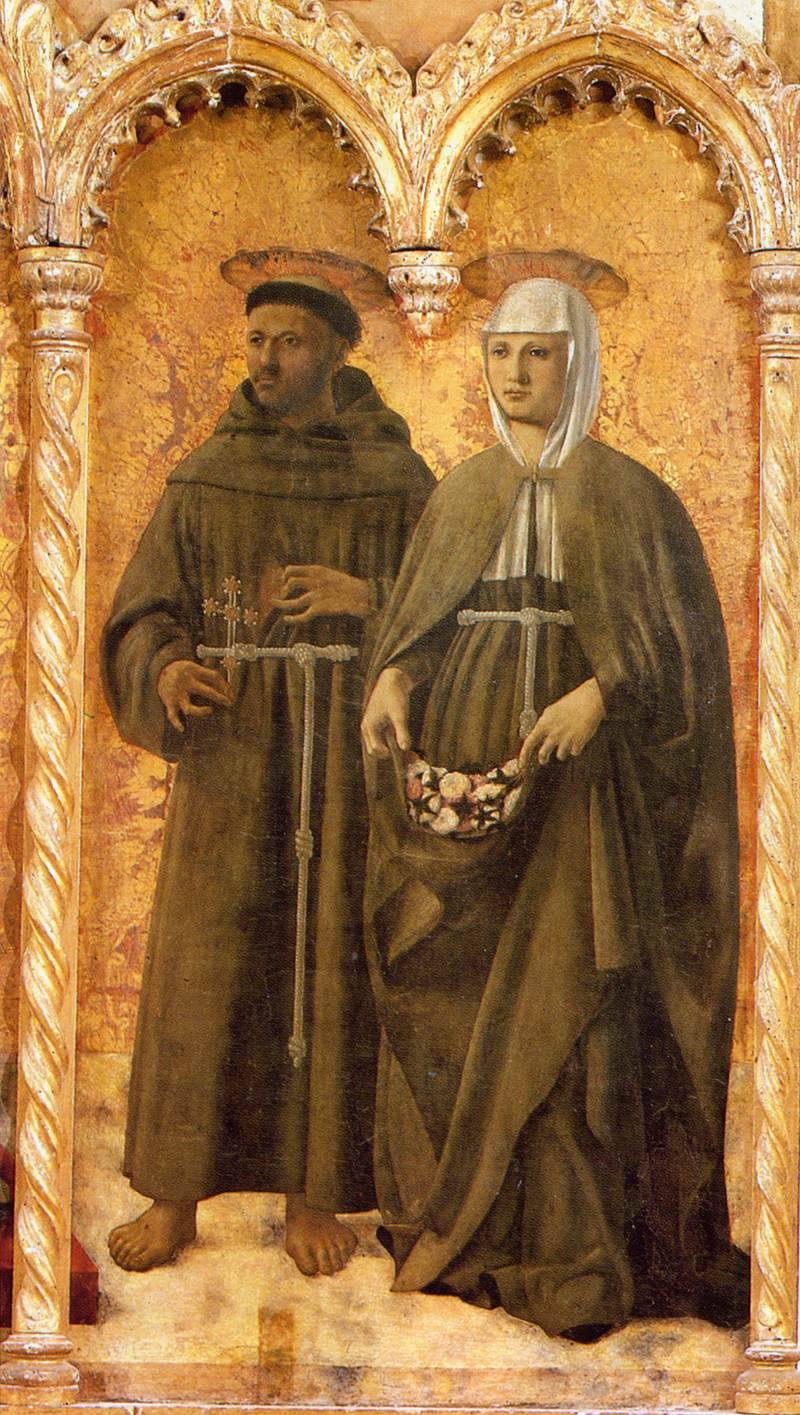
In the paining above St. Elizabeth is bathing a leper or beggar. It is located in her cathedral in Košice, Slovakia and was painted c. 1500. She is often shown with the color red and roses in her apron, like in the painting below, by Piero Della Francesca c. 1460. In this painting she is also pictured with a Fransician friar, most likely her spirital advisor Caesarius of Speier. With the friars' help she founded a monestary in Eisenach and made clothes and provided shelter for the poor. After her husbands death, she became a nun and built a hospital to help the poor even further. 

shhh I know its not red but it has the roses
The miracle St. Elizabeth is most well known for was her Miracle of Roses, which is why shes pictured with them in many paintings of her. When she first got married she began to smuggle bread in her dress for the poor. There were accusations of her stealing treasure from her husband, so he confronted her about it. When he did, a vision of white and red roses fell around her, as the bread had turned into them. Her husband decided she was doing God's work and supported her in her charity to the poor.

After she died at the age of 24, there were miracles of healing being reported at the hospital she built. She was given quick canonization and is now the patron saint of services, tertiaries, widows, and young brides.


Works Cited
Bihl, Michael. "St. Elizabeth of Hungary." The Catholic Encyclopedia. Vol. 5. New York: Robert
Appleton Company,
 1909. 9 Sept. 2016<http://www.newadvent.org/cathen/05389a.htm>.
Online, Catholic. "St. Elizabeth of Hungary - Saints & Angels - Catholic Online." Catholic Online. N.p., n.d. Web. 09 Sept. 2016. <http://www.catholic.org/saints/saint.php?saint_id=45>.
Zaidan, Henry. "Saint Elizabeth of Hungary, 33 Works - RELIGIOUS ART - Paintings from the Bible by the Old Masters, with Footnotes, 18." Mythology:. N.p., 09 Sept. 2016. Web. 09 Sept. 2016. <http://painting-mythology.blogspot.com/2016/05/saint-elizabeth-of-hungary-33-works.html>.


By Morgan Lamkin at September 09, 2016 5 comments:
Email ThisBlogThis!Share to XShare to FacebookShare to Pinterest

The Ornamental Manuscript


St. John from the Book of Kells

The Book of Kells, produced around the year 800 BCE, was a manuscript that contained the four Gospels as well as other customary additions such as the cannon tables. The Gospels were in Latin and were based off of the Vulgate text that St. Jerome wrote. Much of its popularity derives from the extravagant artistry and decoration contained in the book. The incredible work resides in Trinity College Library, in Dublin.

'Chi Rho' - the most famous page in the Book


There is controversy as to where the Book was produced because it combines Irish and Anglo-Saxon styles. This means that it could be from a number of places including, Ireland, Scotland, or Northumbria (now northern England). Around the time the Book was written, a viking raid moved the book to Kells, Ireland. In the 11th century, the book lost its cover (which most likely included gold and gems) because it was stolen. Since then, no harm has come to the book and it has been well preserved.

Sources:


Bennett, Judith M. Medieval Europe. 11th ed. New York: McGraw-Hill, 2011. Print.
 
Snell, Melissa. "The Book of Kells." About.com. N.p., n.d. Web. 9 Sept. 2016.

Spangenberg, Lisa. "XPI Autem Generatio: The Book of Kells and the Chi-Rho Page." Celtic Studies Resources. N.p., 25 Dec. 2010. Web. 9 Sept. 2016. 

"The Book of Kells." Trinity College Dublin. N.p., n.d. Web. 9 Sept. 2016. 


By Unknown at September 09, 2016 1 comment:
Email ThisBlogThis!Share to XShare to FacebookShare to Pinterest

Wergeld

Near the end of the Roman Empire there was a tribe referred to as Burgundians.  The Burgundians followed a set of laws and codes referred to as The Burgundian Code, these laws covered many topics from getting a divorce, kidnapping, murder, and maiming of other Freemen and Romans.
Most of these laws would require that the offender pay a certain price or fine to the victim or the victims family, and the higher up in the social class the victim was,the higher the fine would be as well.


These fines were referred to as wergeld. You would witness many freeman storing away stashes of solidi (revenue used at the time) to be able to pay off wergeld. Another main use of wergeld was to prevent family feuds from ensuing, why fight to the death over a dead horse when you can just pay for it? I consider the concept of wergeld interesting due to the fact of everything seemed to have a price and its place in society all the way from the maiming of an arm to the stubbing of a toe. This concept is also carried out today in a certain fashion by requiring certain offenders to pay bail to be released from holding.


Marc. "The Burgundian Code - Outline." Burgundians in the Mist:. N.p., 23 July 2010. Web. 07 Sept. 2016.


Duhaime, Lloyd. "Burgundian Code (500)." Duhaime.org. N.p., 13 Sept. 2008. Web. 07 Sept. 2016

Drew, K., The Burgundian Code (Philadelphia: University of Pennsylvania Press, 1972)


.McKitterick, R. (editor), The New Cambridge Medieval History (Cambridge: Cambridge University Press, 1995).
By Unknown at September 07, 2016 3 comments:
Email ThisBlogThis!Share to XShare to FacebookShare to Pinterest

The Gateway to the Middle Ages

Throughout the Roman Empire there were more than 50,000 miles of roads. These roads led to the many different townships and outposts that comprised the 3,000 mile (in breadth) empire that the Romans had established. Something that I find very interesting about these many cities within the Roman Empire is the massive arches. I am not discussing the arches that one can see in the architectural style that the Romans used, but instead the massive arches that mark the cities as one enters. After visiting Volubilis in Morocco, where I saw a massive arch over the road, I wondered what its significance may be. As an observer I initially thought that arches such as this could be used to show a city's prominence but my curiosity pushed me to dive deeper into their purpose during the Roman era.
These arches are more accurately called triumphal arches. They had no real function other than the beautiful aesthetics and awe they provide to observers. Despite their lack in function, the arches were built deliberately. The intentions of these arches were to commemorate victories or ascensions to power by rulers (hence the name triumphal arches). They were commonly decorated with sculptures and even inscribed with brass letters. The arch I saw in Volubilis, called the arch of Caracalla, was built to honor the emperor Caracalla who is also know as Marcus Aurelius Severus Antoninus Augustus. He was born to a North African father and Syrian mother, and the arch was to honor not only his lineage to a North African but also his granting citizenship to all free inhabitants of the empire. Overall, the triumphal arches were mere aesthetics used to glorify the Roman empire. What is interesting is that despite this glory and honor the arches symbolized, Rome ultimately fell. And as a result, these arches served the same purpose as what the St. Louis arch does today. To the individuals living after the fall of the Roman empire these arches were mere remnants of that era and, for us, they can be looked at as gateways marking the passage from the Roman era into the Middle Ages.    


Cartwright, Mark. "Triumphal Arches." www.ancient.eu, last modified December 31, 2012.
http://www.ancient.eu/Triumphal_Arch/.
Kolb, Frank P. "Caracalla." Encyclapedia Britanica, last modified February 8, 2008.
https://www.britannica.com/biography/Caracalla.
Photo provided by Ben James, taken December 30, 2014.
https://en.wikipedia.org/wiki/Volubilis
By Unknown at August 31, 2016 4 comments:
Email ThisBlogThis!Share to XShare to FacebookShare to Pinterest

Water Jousting .vs. Jousting


During the Middle Ages, jousting was a very common sport. When participating in jousting, two opponents would ride on horseback and fight using lances. A medieval lance was usually a wooden spear with a metal tip on the end (Lance-Medieval Middle Ages). When discussing medieval sport, most people are unaware of water jousting. When I asked people to describe water jousting to me, they just assumed that it was like normal jousting, but in the water. However, this is a false assumption. While jousting was performed in a court yard at a castle, water jousting took place in rivers. Instead of horses, people who participated in water jousting would stand up near the bow of a boat and use a long pole to try and knock down an opponent in an oncoming boat (Newman).

The illuminated manuscript below shows an example of water jousting. The illuminated manuscript comes from Oxford. By viewing this image, you can clearly visualize how water jousting might have looked. Viewers can distinguish the pole, and the opponent and the other people in the boat.


Newman mentions in his book, "Daily Life in the Middle Ages", that water jousting took place
during the summer as part of a civic festival. One interesting fact that I learned from Newman is that water jousting involved young men from sponsoring towns rather than nobles practicing for war.

I really like water jousting because no one ever got seriously injured during the game. During regular jousting, the opponents have to worry about injury's or death from the lances. In contrast, the worst outcome from water jousting is getting knocked into the water.   


Sources:

Newman, Paul B. "Relaxing and Playing." Daily Life in the Middle Ages. Jefferson, NC: McFarland, 2001. 163-64. Print.                         

Unknown. "Lance - Medieval Middle Ages." Medieval Middle Ages. N.p., 03 Feb. 2013. Web. 29 Aug. 2016. <http://www.medievalmiddleages.com/weapons/lance.html>. 

Illuminated Manuscript:

Oxford, Bodleian Library MS Bodley 264


By Monica Marshall at August 30, 2016 2 comments:
Email ThisBlogThis!Share to XShare to FacebookShare to Pinterest

Galata Tower and the Chain of the Golden Horn

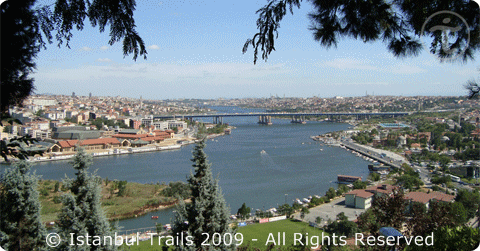
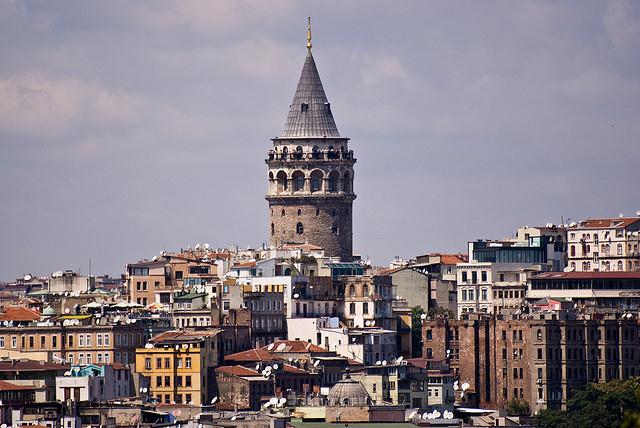
           The great city of Constantinople (now Istanbul) spans two continents, Europe and Asia, and has portions on both sides of the Bosporus Strait. This made the city a prime trade route, with one of the natural harbors in the city being the Golden Horn. This harbor was one of the busiest trade hubs in the city, which made it a prime target for invaders. In order to defend the Golden Horn and the city from naval assault the Byzantines created a great iron chain that stretched across the harbor from one part of the European coast to the Galata Tower along the north side of the harbor. This chain would prevent enemy ships from entering the harbor. 

The Golden Horn as it is today

           Unfortunately for the Byzantines, multiple invaders found ways around the chain and were able to enter the harbor. The two most notable occasions took place in 1204 and 1453. In 1204 Venetian ships destroyed the chain and were able to sack the city during the 4th Crusade. In 1453 Sultan Mehmed II of the Ottoman Empire took his ships out of the Bosporus and used greased logs to transport them across Galata after failing to break the chain, which would weaken the city's defenses. 

A segment of the chain that stretched across the Golden Horn during the siege of Constantinople, located in the Istanbul Naval Museum in The Conquest of Istanbul and Sultan Mehmet, the Conqueror Hall exhibit


           While it may not have always been effective, the great chain that once spanned the Golden Horn was an impressive defensive piece and helped secure Byzantine trade and the city of Constantinople for centuries, and is a part of the city's rich (and bloody) history. 

The new Galata Tower, which was rebuilt by the Genoese after the original tower had been destroyed by looting crusaders in the 4th crusades


http://www.istanbultrails.com/2009/01/the-golden-horn-separates-the-european-shore-of-istanbul-into-two/

http://www.greatistanbul.com/conquest.html

http://www.denizmuzeleri.tsk.tr/en/idmk/sayfalar2.asp?KID=613&SID=267

http://www.greatistanbul.com/golden_horn.html

Goodwin, Jason. "4. The Siege." In Lords of the Horizons: A Aistory of the Ottoman Empire, 37. 1st ed. New York, New York: H. Holt, 1999.
By Unknown at December 03, 2015 6 comments:
Email ThisBlogThis!Share to XShare to FacebookShare to Pinterest
Newer Posts Older Posts Home
Subscribe to: Posts (Atom)

Medieval University

Medieval University

Italy, 1400

Italy, 1400

900s, Jewelled crown

900s, Jewelled crown

Blog Archive

  • ▼  2019 (144)
    • ▼  Dec 1 - Dec 8 (1)
      • Black Death (2010) Film Review
    • ►  Nov 24 - Dec 1 (3)
    • ►  Nov 17 - Nov 24 (1)
    • ►  Nov 10 - Nov 17 (7)
    • ►  Nov 3 - Nov 10 (1)
    • ►  Oct 27 - Nov 3 (30)
    • ►  Oct 20 - Oct 27 (6)
    • ►  Oct 13 - Oct 20 (33)
    • ►  Oct 6 - Oct 13 (3)
    • ►  Sep 29 - Oct 6 (11)
    • ►  Sep 8 - Sep 15 (43)
    • ►  Sep 1 - Sep 8 (5)
  • ►  2018 (19)
    • ►  Dec 2 - Dec 9 (2)
    • ►  Nov 18 - Nov 25 (2)
    • ►  Oct 14 - Oct 21 (2)
    • ►  Oct 7 - Oct 14 (1)
    • ►  Sep 30 - Oct 7 (1)
    • ►  Sep 23 - Sep 30 (3)
    • ►  Sep 16 - Sep 23 (1)
    • ►  Sep 9 - Sep 16 (7)
  • ►  2017 (34)
    • ►  Dec 3 - Dec 10 (2)
    • ►  Nov 19 - Nov 26 (2)
    • ►  Nov 5 - Nov 12 (2)
    • ►  Oct 22 - Oct 29 (3)
    • ►  Oct 15 - Oct 22 (2)
    • ►  Oct 8 - Oct 15 (2)
    • ►  Oct 1 - Oct 8 (4)
    • ►  Sep 24 - Oct 1 (4)
    • ►  Sep 17 - Sep 24 (1)
    • ►  Sep 10 - Sep 17 (5)
    • ►  Sep 3 - Sep 10 (7)
  • ►  2016 (27)
    • ►  Dec 4 - Dec 11 (3)
    • ►  Nov 27 - Dec 4 (4)
    • ►  Nov 20 - Nov 27 (1)
    • ►  Nov 13 - Nov 20 (2)
    • ►  Nov 6 - Nov 13 (1)
    • ►  Oct 30 - Nov 6 (1)
    • ►  Oct 9 - Oct 16 (1)
    • ►  Oct 2 - Oct 9 (3)
    • ►  Sep 25 - Oct 2 (1)
    • ►  Sep 11 - Sep 18 (5)
    • ►  Sep 4 - Sep 11 (3)
    • ►  Aug 28 - Sep 4 (2)
  • ►  2015 (39)
    • ►  Nov 29 - Dec 6 (5)
    • ►  Nov 22 - Nov 29 (4)
    • ►  Nov 15 - Nov 22 (3)
    • ►  Nov 8 - Nov 15 (2)
    • ►  Nov 1 - Nov 8 (2)
    • ►  Oct 25 - Nov 1 (1)
    • ►  Oct 18 - Oct 25 (1)
    • ►  Oct 11 - Oct 18 (4)
    • ►  Oct 4 - Oct 11 (6)
    • ►  Sep 27 - Oct 4 (2)
    • ►  Sep 20 - Sep 27 (2)
    • ►  Sep 13 - Sep 20 (1)
    • ►  Sep 6 - Sep 13 (3)
    • ►  Aug 30 - Sep 6 (2)
    • ►  Aug 23 - Aug 30 (1)
  • ►  2014 (33)
    • ►  Nov 30 - Dec 7 (7)
    • ►  Nov 23 - Nov 30 (2)
    • ►  Nov 9 - Nov 16 (1)
    • ►  Nov 2 - Nov 9 (3)
    • ►  Oct 26 - Nov 2 (2)
    • ►  Oct 19 - Oct 26 (2)
    • ►  Oct 12 - Oct 19 (3)
    • ►  Oct 5 - Oct 12 (2)
    • ►  Sep 28 - Oct 5 (4)
    • ►  Sep 21 - Sep 28 (1)
    • ►  Sep 14 - Sep 21 (1)
    • ►  Sep 7 - Sep 14 (2)
    • ►  Aug 31 - Sep 7 (2)
    • ►  Jul 20 - Jul 27 (1)

Popular Posts

  • The Grindstone
  • Medieval Fine Cakes
  • With the Horse Collar Comes Productivity
  • An Uncover Squire-A Knight's Tale
  • Not One, Not Two, But THREE Field Crop Rotation

Featured Post

Get Medieval: Write in Your Books

Will your class coursepacket look like this? As we start our first weeks together, and for some of you, your first week of ...

Search This Blog

Copyright HIST 223 authors. Picture Window theme. Powered by Blogger.