Ice Skates: Transportation or Fun?

The time for play and fun was not lost on the people of the early Middle Ages, instead embraced in many different ways. Many activities came about from aspects or things that the surrounding area or townspeople could already provide. A great example of that would be the pass time of ice skating. Ice skating was a common activity in northern countries such as Scandinavia and also some of the low countries. During the winter months, ponds and lakes naturally freeze over, giving the people a "nature provided play ground." Now that the playing field has been made, towns people would use bones from their kills to create the blade for the ice skate. Then, with the added straps of leather, would fasten the skate either around a foot or a boot. Along with the ice skate, participants would also use two long poles to help propel them forward. The commonly known motion of ice skating was actually rarely used. In most cases, individuals would use the ice skates as a gliding mechanism as they used the poles as the momentum aspect.


There is debate over whether the invention of the ice skates were more for fun, or for a better means of transportation during the winter months. Many argue that ice skates were used for both, but mostly for the use of leisure activity. Ice skating was an activity that could be participated in by both the young and old, and was a way to bring the townspeople together in a shared activity. The stereotype of the Medieval times tends to fall under "all work, no play" but in actuality, the people of this time spent a good amount of time enjoying the activities they did together, or separately. 

Religion being a prominent figure and influencer of the time, means that many artifacts can some how be tied back to the Church. The ice skate is no different. A young women named Lidwina, was ice skating one day and fell and broke her rib. She was taken to a covenant to heal and later became a part of the order. Years later, after her death, Lidwina was named the patron saint of skaters. 


Sources: "Daily Life in the Middle Ages." Paul B. Newman. McFarland & Company. Jefferson, North Carolina. (page 165, 167)

"Ice Skating" Editors of Encyclopedia Britannica. https://www.britannica.com/sports/handball

How To Train Your Dragon

Image result for how to train your dragon 1
How to Train Your Dragon (2010) is an animated movie set in the medieval Isle of Berk, home of the Hooligan Tribe vikings. It is a dramatic, yet playful take on the common misconceptions and stereotypes of medieval Europe and of the vikings themselves. The ideas and imagery that the movie conveys and that many people tend to think of when they hear the words ‘medieval’ or ‘viking’ are more of medievalisms rather than an actual historical depiction of the time. Contrary to popular culture, vikings did not actually wear metal hats with horns on them, or speak with thick, almost unintelligible Scotish accents. Many of these cliches are results of celtic folklore interpretation (especially dragons), and the media industry. 
Image result for how to train your dragonHow to Train Your Dragon uses these traits of medieval culture successfully to portray a heartwarming story about a young, frail boy named Hiccup whose main concern is to prove himself to his father and to become a skilled dragon fighter. What becomes of Hiccup though, is the opposite of what he wished. Instead he encounters one of the most dangerous species of dragon, and (you guessed it), trains him! Hiccup and his dragon Toothless then come face to face with what they called The Red Death, the most vicious of the dragons whose name could be a nod to The Black Death of the Middle Ages. Hiccups attempt to show that humans and dragons can live in harmony fails during one of his class exercises in dragon hunting, and Toothless is captured by the chief of the tribe, Stoick. This leads to the invasion of the dragon’s nest, and the waking up of The Red Death. As any children’s movie ends, Hiccup and Toothless prevail and dragons and vikings learn to live in peace with one another.
The film is very much based off of the stereotypes of medieval vikings. At one point in the beginning of the film Hiccup says, "we're vikings, we have stubbornness issues" which immediately shows the use of common misconceptions within the movie. Though Hiccup has no accent, many of the big, burly viking characters speak through an intense, almost exaggerated Scottish accent. The horned hats, red hair, long beards, and beer bellies can be added to the list of not-so accurate traits. 
HelmetsThe helmet in the image on the left is a copy of a warrior’s from a grave at Gjermundbu in Norway in the National Museum of Denmark. What the museum writes is that "...horned helmets/heads, such as upon the Golden Horns. Similar images are also known from the Viking period itself...Does this prove that all Vikings wore the famous helmets with horns? The answer is probably not." (National Museum of Denmark). Tacitus' Germania could be attributed to the stereotype of beer drinking barbarians as he writes that no other people indulge like the barbarians, and follows by saying, "Their drink is a liquor made from barley or other grain, which is fermented to produce a certain resemblance to wine." (Tacitus).
Though there are inaccuracies, the film takes place in a fictional setting that is very similar to the actual environment that would have occurred at this place and point in time. It places its characters in a realistic setting, as well as providing attire that is pretty similar to what vikings actually wore, like tunics and such. Although it is a stereotype, the ginger hair and large body type might not be entirely wrong as historical accounts of celtic peoples have described them as such.
Altogether, it is clear that the movie does not do history justice. It is not historically accurate, and that is simply because it is a children’s fantasy/adventure film. What many people, especially children understand as ‘medieval’ is precisely what How to Train Your Dragon depicted to get across the wholesome message of creating peace. What has become of the image of vikings is a result of modern imaginitivity being fused with stereotypes, biases, their polytheistic characters, and more. That being said, the movie was made for the correct audience, and if you are a college student in a medieval history class, this movie may not be for you.


Joyeuse: The Legendary Sword of Charlemagne not to be confused with Kid Rock’s sidekick, Joe C


In the book, The Song of Roland which is based on the Battle of Roncevaux in 778 c.e tells about King Charlemagne heading into battle with his sword named Joyeuse by his side.

“Charlemagne was wearing his fine white coat of mail and his helmet with gold-studded stones; by his side hung Joyeuse, and never was there a sword to match it; its color changed thirty times a day.”

Throughout history there have been many of great weapons wheeled by great men. There is Thor’s hammer, King Arthur’s Excalibur, and King Charlemagne Joyeuse to name a few. There were always rumors that these great weapons had magical powers imbued in them. Joyeuse was herald as to protect the man wielding it from being poisoned. The name Joyeuse means joyful in French.

Powerful men realized the significance of this sword and what it represented. Joyeuse has been used in coronations of French Kings for centuries. Napoleon Bonaparte and King Louis the X have used Joyeuse in ceremonies. This sword has been modified over the centuries for several prominent people. It was modified in the 10th, 11th, 12th, and 13th centuries. The scabbard was also modified with velvet.


 King Charlemagne sword has been on display in Paris France, at the Louvre Museum since the French Revolution. It was moved there from the Abbey of Saint Denis along with many other artifacts.


Works Cited

Harrison, R. (2002). The Song of Roland. New York, New York: New American Library, a divison of Penguin Group Inc.
HILL, B. (2015, May 7). Joyeuse: The Legendary Sword of Charlemagne. Retrieved from ancient-origins: www.ancient-origins.net/artifacts-other-artifacts/joyeuse-legendary-sword-charlemagne-003020
Muriel, B. (n.d.). Coronation sword and scabbard of the Kings of France. Retrieved from Louvre :


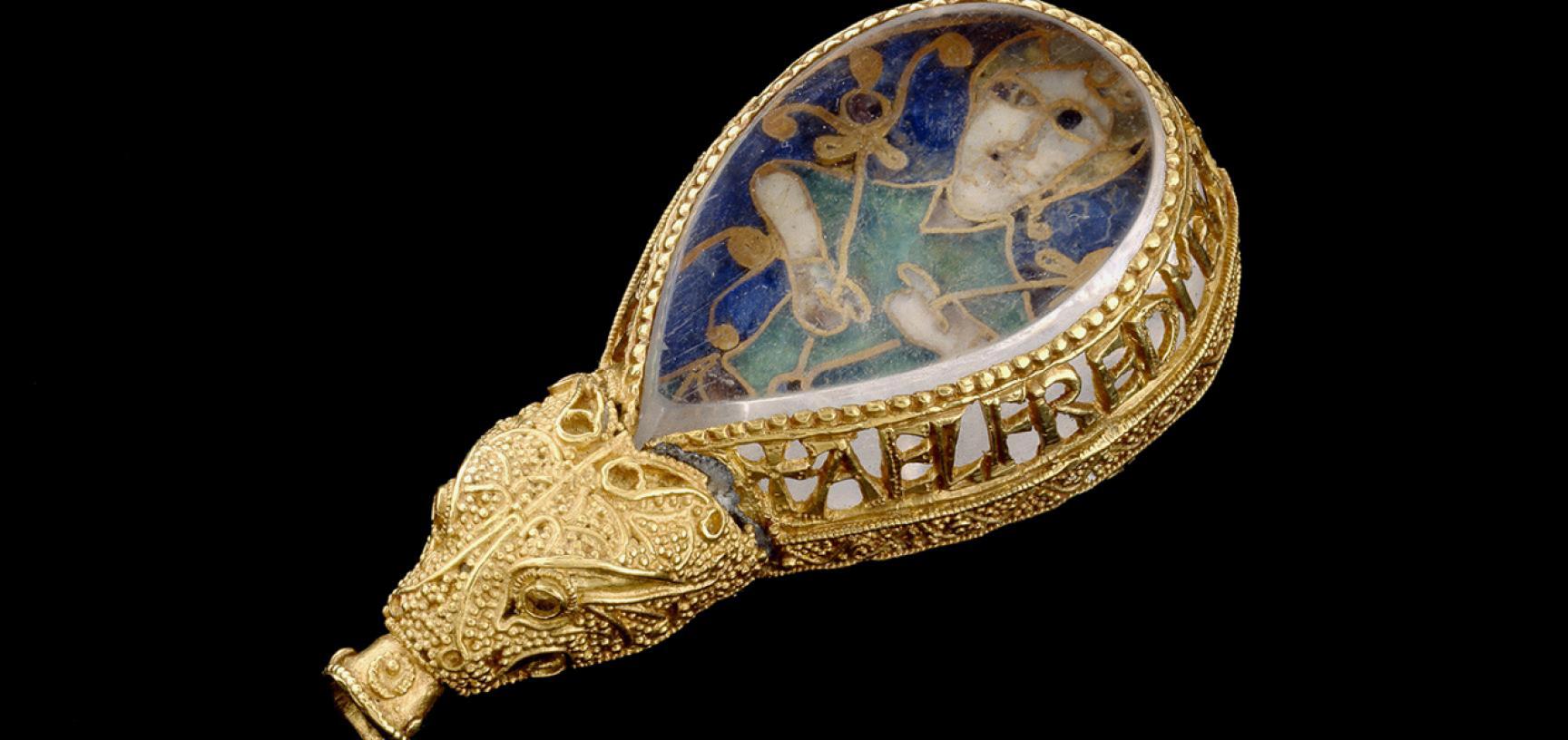
The Alfred Jewel


The Alfred JewelImage result for the alfred jewel

The Alfred Jewel is a gold reading pointer formed around a tear shaped rock crystal.  This magnificent artifact was discovered in a field a field a few miles away from King Alfred the Great's  fortress and monastery at North Petherton, Somerset in 1693 while being plowed. The location this artifact was found at is believed to be where King Alfred the Great had his counter-attack on the Great Army of the Vikings, which led to his much needed military victory at Edington in 878 and the expansion of his authority across the southern half of England. 

One of the most significant details besides the intricate complexity of the gold work is the artifact is it is inscripted with the phrase "AELFRED MEC HEHT GEWYRCAN" along the side, translating out to "Alfred ordered me to be made".  Also, the dragon like head at the base of the jewel holds in its mouth a  socket which was used to hold the actual pointer (missing) that might've been made from ivory or wood. The figure found on the top layer of the rock crystal is said to represent the sense of sight, perfect for expressing on one's commitment to christian learning. Some manuscripts like the Alfred  Jewel were distributed throughout King Alfred's kingdom as pointers used to follow along text to help ones reading. 

Source:
“ALFRED JEWEL.” ALFRED JEWEL | Ashmolean Museum, https://www.ashmolean.org/alfred-jewel.
“Alfred Jewel.” The British Library, The British Library, 16 Oct. 2018, https://www.bl.uk/collection-items/alfred-jewel.


Finger Ring with a Cross- Frankish Artifact


 Finger Ring with a Cross

Throughout the Middle Ages, finger rings were common among those who were of higher rank. Some rings of the ages had monograms and names crafted into the metalwork were used to seal important documents. However, most rings were used and seen as accessories to add to already opulent apparel. Like most jewelry of the time, rings were made from gold, as well as sometimes silver. They were crafted with different precious stones such as amber and emeralds. Many different metalworking techniques were used for jewelry during the time as well.

This ring specifically is Frankish, originating from France between 450- 525 C.E. The ring most likely belonged to a Frank that was of a high ranking and was worn as decoration as well as to represent the wearer's Christian faith. The fine craftsmanship of the ring helps to demonstrate the sophistication of the Franks when it came to metalwork. The intricate spirals of metal and the use of the garnet and mother-of-pearl add a layer of beauty to the piece as well as to indicate the amount of work the Frankish put into their metalworking for not only rings, but other jewelry and crafts as well. 


Artifact #1- Thor's Hammer Pendant


Thor's Hammer Pendant 

     The Thor that we are all familiar with today does not quite hold truth to the Thor that was familiarized in the Viking-Era. He was in fact son of Oden and temperamental thunder-god; however, his physical image was more or less skewed for modern pop-culture. According to the Swedish Natural and Cultural History Museum Thor was, "the god of farmers and free people. He is temperamental, with red hair and bushy eyebrows" (Pictured Right). He is also well known for having three key pieces of weaponry that aid him in his quest to defend Asgard: Megingjord, the belt of power that doubles his strength; a pair of iron gloves; and Mjolnir, his ever so famous hammer that hits whatever it's aimed at without fail and returns to his hand like a boomerang. 

     Thor's hammer typically has a grander scheme of uses to viking's and their heirs other than helping Thor guard Asgard. According to historian Hilda Roderick Ellis Davidson, 

      It would seem indeed as though the power of the thunder            god, symbolized by his hammer, extended over all that had        
      to do with the well-being of the community. It covered                
      birth, marriage, and death, burial, and cremation ceremonies, weapons and feasting, 
      traveling, land-taking, and the making of oaths between men. 
      The famous weapon of Thor was not only the symbol of the destructive 
      power of the storm, and of fire from heaven, but also a protection against the 
      forces of evil and violence. Without it Asgard could no longer be guarded against the        
      giants, and men relied on it also to give security and to support the rule of law. 

This summary highlights the uses of the pendant to the viking people and anyone who celebrates viking culture in the modern day. 

     This artifact that I have chosen to talk about is Thor's Hammer pendant that is kept in the gold room of the Stockholm history museum, Historiska Museet (Pictured Above). This piece of precious viking gold was found in one of the many viking-era hoards that get unearthed in the modern world. Thor's hammer was made into pendants that warriors would wear in order to gain protection and strength from Thor himself. This piece helps illuminate the Middle Ages because it symbolized something that was very important to viking culture. It can also be used to preserve the tradition of oral storytelling if you're wearing it and someone asks you what it is or where it came from. You can proudly tell them the story of Thor, Oden, and Asgard that your ancestors held dear to their hearts.


 Sources:
“Gold from Viking Hoards.” Viking Gold, Stockholm , 21 Jan. 2014, http://users.stlcc.edu/mfuller/vikinggold.html

 McCoy, Daniel. “Thor's Hammer.” Norse Mythology for Smart People, 2012, https://norse-mythology.org/symbols/thors-hammer/

“Thor – a Temperamental Thunder-God.” The Swedish History Museum, Historika Museet,  https://historiska.se/norse-mythology/thor-en/ 

Medieval University

Medieval University

Italy, 1400

Italy, 1400

900s, Jewelled crown

900s, Jewelled crown