The Unique Find from Silacwine

William the Conqueror (or as known by some as William the Bastard) is mostly remembered as being the first Norman King of England. Although distantly related to King Edward the Confessor (reigning from 1042-1066), he still had a legitimate claim to the throne--and succeeded in taking the crown. He ruled from 1066 until his death in 1087, establishing an aristocratic regime and erecting numerous castles throughout the land, strengthening royal power. He helped transform England into what it is today and is an important figure in the history of the Middle Ages--even being depicted in the famous Bayeux Tapestry with his half-brothers.


Just recently, in 2011, a hammered silver coin was found in England. This find was actually a unique silver penny of William himself dated from around 1077 to 1080. Engraved into the face of the coin are the words "PILLELM X" translating to "William the King" along with his face. On the reverse side is a cross pattée and the words, "[S]ILIACPINC ON GLI" translating to "Silacwine of Gloucester", the name of the moneyer. This amazing discovery was the first and only example of coins minted in Gloucester in that time period and that "the discovery of this coin therefore proves that the mint was in operation throughout the whole reign of William I" ('Unique'). During his reign, William the Conqueror had at least 70 mints producing coins. 
History is once again proven to be fascinating when artifacts like this one are discovered. There are many missing pieces, but when one puzzle gets solved, the picture always turns out to be worth it.


Works Cited:

Bennett, Judith M. Medieval Europe: A Short History. McGraw-Hill, 2011.

'Unique' 11th Century coin discovered near Gloucester

Unique William the Conqueror silver penny found


Regal Runes: A history of the Germanic and Norse alphabets

                                    The earliest accepted example of Germanic runic writing is the inscription found on the Meldorf Brooch (dated to around 50 CE in northern Germany). It possibly reads "Hiwi" meaning spouse or husband. I theorize that this might have been a wedding gift or a "bride price" of sorts or perhaps a good luck charm/talisman for al  newlywed couple.

The ancient Germanic Tribes and their Norse cousins who followed their example centuries later are unfairly characterized as barbaric, ignorant, and illiterate. This couldn't be any more untrue than it already is. For quite some time the peoples of Germania and Scandinavia had knowledge of a functional alphabet long before the introduction of Christianity into Northern and Central Europe. While in its early stages it wasn't as sophisticated or as legible as the Roman and Greek alphabets the development of the "Futhark" script was still a significant cultural achievement (besides the Celts, the Norse and the Germanic Peoples were the only "Barbarian" group to develop their own writing system independent of Christian missionary activity).


This is the Negau helmet which was found in Slovenia and was dated to 400BCE . This is the earliest example of the Germanic language being put in writing. It reads "harikastiteiva" it is generally read as Harigast the priest. The helmet itself dates back to 400 BCE but the inscription itself was most likely added around 200 BCE.

The First example of a Germanic language being written down is inscribed on the Negau helmet. It is written in the Etruscan Alphabet which Germanic Runes likely evolved from. There are artifacts of a similar type scattered throughout the Alpine Region (the ancient contact zone between the Celtic, Italic, and Germanic peoples) and it shows how quickly the Germanic tribes were able to appropriate a foreign script and adapt it for their own purposes. As runes became a uniquely Germanic alphabet they became to be used in a uniquely Germanic/Norse context. They were associated with magic, strength, and wisdom, and they are often connected to Wotan(Odin). Runic inscriptions of this type are often found on spearheads and jewelry.
A golden disk found in Funen Denmark the inscription reads:
"houaz laþu aaduaaaliia a" 
The term houaz is a cognate with Norse
hávi meaning Odin 

 The runic alphabet did not disappear following the romanization and Christianization of Germany. The Norse and for a time the Anglo Saxons, themselves Germanic peoples continued to make use of runes creating beautiful works of art and stunning rune stones. 

 In conclusion despite their depiction in popular culture the Germanic peoples and the Scandinavians actually have a literary and material culture dating back 200 years before the year zero and all the way into the middle ages! As people today often view Europe as a monolithic cultural block of sameness I believe that it is important to look back on the values and talent of the ancient and medieval cultures for inspiration. After all we will all lose a great part of our global heritage by ignoring this extraordinary cultural history that has been intentionally written in stone for the benefit of future generations.

works cited:
 National Museum of Denmark

Norse Mythology For Smart People

Revolvy

The Development of Old Germanic Alphabets  

Talisman of Charlemagne


As we are learning about Charlemagne I was very interested in some of the artifacts that came around this time, but one that I found is so elegant, the piece is called Talisman of Charlemagne. This piece is a huge necklace sapphire encrusted with pure gold and precious gems. It was also said to be named The Talisman of Charlemagne, because supposedly in 800 Charlemagne was Crowed the Holy Roman Emperor of all of Europe all because he chased the Lombard’s out of Europe, one year after his crowning according to L’Ecole School of Jewelry Arts the piece was made and given to Charlemagne by either the Harun al Rashid or Queen Irene of Constantinople.


After Charlemagne had received the Talisman of Charlemagne it was said by many historians that he had worn it, in battle and he was buried with it, but because he had been unburied so many times the Talisman was taken out of his grave and given to Josephine de Beauharnais, she held on to it for the rest of her live until; She then leaves it to her daughter who love Talismans very much, she even made them to give to people, so on it made it way to Empress Eugenie. When Empress Eugenie was later confronted to return it to Aix-la- Chapelle, but because of I believe World War I she Changes her mind and gives it to the Cathedral of Lies you can actually go see it today.  


Real live picture of Talisman of Charlemagne


Works Cited

Students of Occult History, Los Angeles. “The Talisman of Charlemagne.” Students of Occult History, www.studentsocculthistory.com/talisman-of-charlemagne.html

Joailliers, Itinéraires. “Charlemagne's Talisman at the Palais Du Tau, Reims.” The French Jewelry Post by Sandrine Merle, 9 May 2017, www.thefrenchjewelrypost.com/en/it-joailliers/talisman-de-charlemagne-palais-tau/.

Unknown. “The Talisman of Charlemagne.” L'École Des Arts Joailliers, 31 Mar. 2016, www.lecolevancleefarpels.com/en/video/talisman-charlemagne.

The Ulfberht


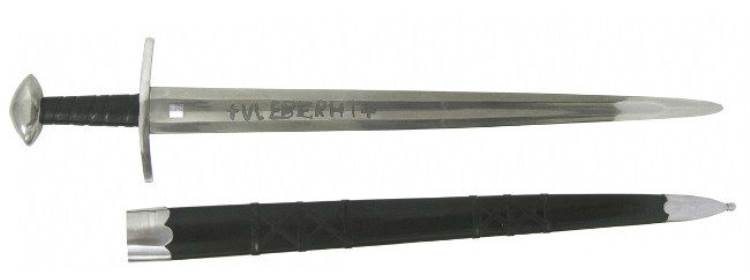
When we think of Viking warriors, we usually think of warriors with odd helmets armed with large long swords. While this isn't completely incorrect, its not entirely accurate either. Vikings didn't wear horned helmets, nor did they all use large swords. Most Vikings were armed with axes or long spears. To have a sword was a sign of wealth and strength. 


To own a sword with the brand name "Ulfberht" was to own one of the finest weapons that could be made. These swords were much tougher than your average sword in this time period due to the added carbon. The added carbon not only makes the steel much stronger, but also makes it less brittle. If you were to get this sword stuck in a shield, it would be less likely to break.This is thanks to the added flexibility.With all these added properties the "Ulfberht" swords were more rare and expensive than their average counterparts.

Works Cited 

https://www.theguardian.com/artanddesign/2014/mar/03/viking-world-british-museum-neil-macgregor-exhibition

https://www.realmofhistory.com/2016/03/08/ulfberht-swords-advanced-viking-weapons/

http://www.pbs.org/wgbh/nova/ancient/secrets-viking-sword.html

An Age-Old Curse


When it comes to Viking culture, one of the most distinct elements is the runic alphabet that they used to tell stories of their people, record their beliefs, and in this case, threaten curses upon people.

Image result for the glavendrup stone

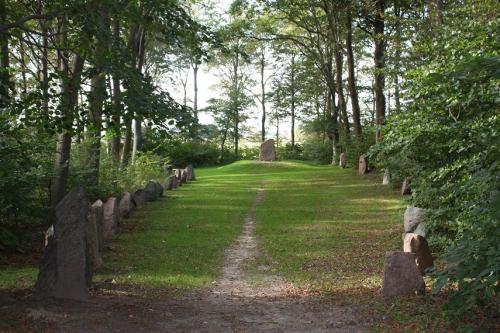
The Glavendrup Stone, which is a large runestone that dates back to the early 10th century (the middle of the Viking age), resides in Funen, Denmark. It stands at the end of a stone ship, which is a burial site where—as the name suggests—various stones are placed to form the shape of a ship. Nine graves have been found within the stone ship, all of which are empty.

Discovered in 1794, the Glavendrup Stone is the second largest text on a runic stone in Denmark at 210 characters long. The text translates to: 


Ragnhild placed this stone in memory of Alle, priest of the Soelve, honorable clan chieftain. Alle's sons made these runes after their father and his wife after her husband. And Sote carved these runes in memory of his master. Thor hallow these runes. To a "something you do not want to become" become he who uses violence on this stone or drags it away to stand in memory of somebody else.


There is some debate concerning the translation of one of the words (i.e "something you do not want to become"), but it is believed to be along the lines of "warlock," "wretch," and "outcast"—the bottom line being Thor will not be very happy with you if you vandalize the Glavendrup Stone. 


Works Cited

Vikings Don't Really Train Dragons...Right?


Contrary to its title, the DreamWorks animated movie How to Train Your Dragon is not just about dragons. The film follows the life of a young boy, Hiccup, who just does not fit in when it comes to his family, his village, and even his culture. He feels like an outsider, which is something that could be frowned upon considering Hiccup is...well, a Viking.

Known throughout history as ruthless, barbaric warriors, Vikings "were canny traders as well as cruel raiders" they were "the most fearsome invaders of all" (Bennett). These groups of invaders were spotted along the English Channel, on the continent, the North Atlantic, and the Russian States. But Vikings we actually a very intelligent bunch. Thanks to their extensive knowledge in geography and on the surrounding kingdoms, "strong trade networks helped Vikings know where and when to attack. Raiding, in turn, promoted more trade, as Viking would sell in one place what they had plundered in another" (Bennett). While not the most moral of actions, it's hard to argue that the Vikings weren't unaware of what they were doing when it came to money.

This movie, in particular, may not wholly focus on the factual life of Vikings but instead what their life would be like if they coexisted with dragons. From the beginning, we see the animosity between the village and the dragon species. The Vikings in this movie are seen with traditional clothing such as furs, leathers, and cloths. Even shown are the infamous the horned Viking helmets we all know and love. The characters (execpt for a select few for some reason) all have a heavy Scandinavian accent and wear braids in their hair, ranging from short to long hairstyles. They are also big and burley people--at least a majority of the characters are.

As mentioned before, Hiccup is seen as an outsider. Because he is small, skinny, and does not think of dragons as a nuisance like the rest of the village, he does not fit in. Most importantly, because he does not want to fight and kill, he is seen as weak. Yes, the Vikings are notorious for their violence, but that is not the only defining trait they have. But we see Hiccup can be strong in his own. He eventually learns to stand up for himself and gets the whole village on his side to fight with the dragons to defeat an even bigger threat.

Although this movie may not be the best one to accurately represent how Vikings lived, there are still many characteristics that are consistent with the records shown throughout history such as hairstyles, clothing, and an interest in fighting. Of course, the animated film was "Disney-fied" so many aspects were made for and aimed towards children. All in all, How to Train Your Dragon is a movie that can set the bare, child-proof basics of how Vikings lived back then. And... dragons are a good plot device in a children's movie, too.


Works Cited:

How to Train Your Dragon (2010) DreamWorks

Bennett, Judith M. Medieval Europe: A Short History. McGraw-Hill, 2011.

https://www.nationalgeographic.com/magazine/2017/03/vikings-ship-burials-battle-reenactor/

Medieval University

Medieval University

Italy, 1400

Italy, 1400

900s, Jewelled crown

900s, Jewelled crown