Gratian's Decretum: Changes in the Papacy and the way we see Law

During the Middle Ages we see many evolutions of scholastics and tendencies of education within the society. The education of people came from the monasteries and cathedrals, from which many universities today are inspired by. There was teachings of grammar, mathematics, sciences, and philosophy, however, a large portion studied law. A text from the 12th century created a guiding for studying and going about Canon Law, known as the Decretum. It was a collection of 3,800 texts that showed regulations and church discipline that was by a Benedictine monk known as, Gratian. 


During the 5th and 6th century we see the Benedictine rule arise under St Benedict, himself. During his rule he created a set of regulations that were appointed by him and the church to try and clean up the behavior of the people. However, the regulations were rather intense and some even seemed to be a little absurd, like don’t be to happy. Some of the texts within the Decretum were derived from the benedictine rule, there are probably a few texts that came straight from Benedict himself. This collection of texts changed the way people studied Law and even modified the Papacy. Popes were no longer coming from just monasteries anymore, rather they started to emerge from the people who studied canon law and were highly involved in the Papal politics (Bennet 182-183). Alexander III was an example of such a feat, along with many of his successors, changing how people saw the papacy and the study of law.


The Editors of Encyclopædia Britannica. “Gratian's Decretum.” Encyclopædia Britannica, Encyclopædia Britannica, Inc., 28 Jan. 2015, www.britannica.com/topic/Gratians-Decretum.

Bennett, Judith M. Medieval Europe: a Short History. McGraw-Hill, 2011.

License To Kill: Letters of Marque in the Middle Ages

Image result for letter of marque middle agesHave you ever wished for the opportunity to get away with something that would usually entail some caliber of consequence? Be it when we were 8 or even in our late 80s, we all have that guttural feeling to do something we aren’t supposed to every once and a while. We have the thought, “Oooooh if only that weren’t illegal or socially divergent, I’d totally do it!” or more likely, “Oooooh you have wronged me good sir and I wish to take my revenge!” But alas, our current legal and social systems are too stingy and don’t want us going around enacting our own manner of vengeful justice. It’s like they’re afraid that people will get hurt or something; REDICULOUS! Well if you’re like me and you’re tired of not being able to take out Batman-like vigilante revenge on your own, then CONGRADULATIONS! You may be among the incredibly minute percentage of our population who would have preferred living in the Middle Ages; if only for a little perk known as the law of marque.

Image result for letter of marque middle agesThe law of marque was an international system of dealing with grievances similar to those mentioned above; the law has origins dating back to the 9th century and was even practiced up into the 19th. Formally, the law of marque revolved around the acquisition of letters of marque or reprisal that, straight from the encyclopedia, “authorized their possessor(s) to seize property owned by citizens or subjects of a territorial state or civic polity in retaliation for that polity’s failure to furnish ‘justice,’ in the form of restitution, for a previous injury inflicted by its subjects or citizens” (Friendman & Figg). That’s a bit of a mouthful I know, so informally the law of marque revolved around the acquisition of letters of marque to legally take action against hostile nations or pirates. Be it by seizing cargo and splitting the proceeds with the crown, such as under the rule of King Henry III of England in the 13th century, or in other ways taking reprisal (I suppose that wasn't any simpler of a definition) (Hammond); which was obviously right up everyone’s ally! 

In Western Europe, those active in commerce often sought these letters to legitimate forays against the aforementioned assailants and they were often a remedy in cases of robbery, abduction, and commercial disputes (Friendman & Figg). For example, around 1300 A.D., the recently widowed Margery Russell, whom had just inherited her husbands import-export business in Coventry, England, had one of her ships, laden with 800+ English pounds of goods, was knocked off whilst in route (León). Suspecting Spanish pirates, she requested letters of marque  from the English court against Santander, Spain, the port of said pirates. These letters enabled her to forcefully (with English legal backing) claim the holds of two Spanish ships; their value's representing substantially more than her stolen goods. Unfortunately, in this sense letters of marque were often used as a business tactic, which caused much legal anguish from the Spaniards (León). These letters were essentially the modern equivalent of a 007-esque legal license to kill; although these letters didn't necessarily imply the necessity of killing...but I'm sure that wasn't all too regulated given the circumstances.


Citations:

Hammond, Willian C. “Letter of Marque.” Historic Naval Fiction, David Hayes, www.historicnavalfiction.com/general-hnf-info/naval-facts/letter-of-marque.

León, Vicki. Uppity Women of Medieval Times. MJF Books, 1998.

Friedman, John Block, and Kristen Mossler Figg, editors. Trade, Travel, and Exploration in the Middle Ages An Encyclopedia. Routledge, 2014.

Spinning Through Time: The Distaff and Spindle

(Photo Credit)
The creation of medieval textiles was a long and arduous process. One that required a lot of time and patience for every person involved in the process. Wool, for instance, had to be treated in a special way to ensure it was ready for use later. Wool needed to be washed, greased, and then combed before the fibers were ready for spinning. Spinning is the process in which raw fibers, like wool, are made into thread that later becomes cloth.


(Photo Credit)
Spinning, a process mostly done by women, required two important tools, the distaff and spindle. The distaff would hold the treated wool in an orderly manner while the spinster would pull the fibers off the distaff. The right hand of the spinster would control the spindle, keeping it moving, twisting the fibers till it turned into thread. (A process that if one tries to emulate requires an incredible amount of coordination.) The thread made in the process would then be used by a weaver to make cloth. Due to the amount of time that the process took, a distaff and spindle allowed a portable solution while still able to make strong thread. While new technologies, like the spinning wheel, replaced the distaff and spindle both tools are still used to spin thread.

Sources:
Alvarez, Sandra. "Handspinners of the Later Middle Ages and Renaissance." Web blog. Medievalist.net. January 6, 2013. Web. accessed October 19,2017. LINK

Medievalists.net. "The Middle Ages Unlocked: Medieval Crafts." Medievalists.net, July 15, 2015. Web. accessed October 19, 2017. LINK

The Smithfield Market: A Millennia Old Marketplace


The area that comprised the Smithfield Market had been in continuous use since the tenth century. Smithfield market is Britain's oldest meat marketplace and has been a hub of economic exchange throughout London's history. The Smithfield Market, since the twelfth century, has been the sight of massive trading in meat, livestock and other agricultural goods. The Smithfield Market helped London to become the nucleus of trade in England and a hub for agricultural exchange in the region. Originally the area that would become Smithfield Market was a livestock market on the outskirts of London that traded in everything from cattle, horses, swine, and even poultry.  By the twelfth century Smithfield Market had begun to sell meat and not just livestock. 


Livestock from all over England would be brought to the Smithfield Market to be traded and bought and sold. By the twelfth century the market place was described as a place where animals of all kinds, especially cattle and horses, could be bought and sold. The site was even used to host fairs and festivals from time to time. The modern Smithfield Market does not sit on the same land that the original did. Due to the expansion of London's residential areas into the former outskirts of the city where the Market was located. The Smithfield Market was moved to the site where it still sits as the largest meat marketplace in all of Britain.

Sources

Rottenberg, Simon. "Monopoly in the Labor Market: The "Bummarees" of London's Wholesale Meat Market" ILR Review, vol. 13, no. 1, October 1956, pp.54-63,http://www.jstor.org/stable/2519493   

Porter, Roy. London: A Social History. Penguin Books, 1996.

Werner, Alex. "A Brief History of Smithfield" Museum of London, 26 March 2015, http://blog.museumoflondon.org.uk/history-smithfield/

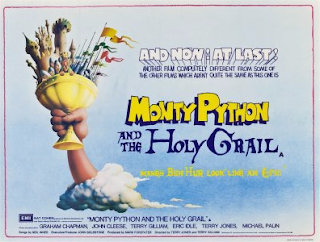
Review: Monty Python and the Holy Grail

(Photo Credit)
(Photo Credit)

For those unfamiliar with the comedy style of Monty Python, a step into their world can be seen as strange and peculiar. The group is best known for their ability to satirize just about anything they chose at the time. One could think of their comedy as a giant, “what if?” where people and things are put out of context to show their truly perplexing qualities. Most notably on their television series, the group would frame absurd sketches like questioning what would happen if Hitler escaped to England, changed his name, and lived like a typical English-person? Awkward, and sometimes uncomfortable, scenarios like this are the specialty of the comedians of Monty Python and they take this unique comedy into their classic 1975 film Monty Python and the Holy Grail.

The film is set up to share qualities with famous medieval epics, like The Song of Roland, which instantly is noticeable with the inclusion of the heroes of the movies, King Arthur and his Knights of the Round Table. Along with the legendary characters in the story the movie includes, like Bennett alludes to, an adventure of epic proportions, blood and gore, and characters able to survive their mortal injuries (which becomes a running gag throughout the movie) (283). The movie has many memorable scenes like these including, the black knight, whose limbs are all cut off but yet he is still ready and willing to fight (hopefully this is reminiscent of The Song of Roland).
(Photo Credit)

What the film does well in this epic-like styling is ask, what if medieval knights, who supposedly have these legendary traits and abilities, are not that legendary nor epic and instead flawed humans? In this context, viewers can begin to think about their preconceptions of the medieval period and see how some of the preconceptions are a little embellished. Like how Arthur and his Knights towards the end of their quest, fail to defeat a small but ferocious bunny, which kills most of the group, in close combat.

Although, not entirely accurate for historical purposes, the film does hit upon some truths about medieval life while greatly exaggerating most other aspects. The film’s main story features King Arthur and his Knights, who are called by God to go and search for a holy relic that is revealed to be the Holy Grail. The combination of religion and the ruling powers of a kingdom were an important part of medieval governance since Charlemagne. Furthermore, kings did include some religious aspects to their territorial expansion and conquests. Religion, especially Christianity, shapes the characters in the film and their adventures. This includes one knight named, Sir Galahad the Chaste, whose encounter with a castle that is only inhabited by women leads him to desire to be less than his name before being rescued by his fellow knights. For the most part, the mail that the knights wore showed how knights were still able to move even with heavy armor on.

The greatest historical fault to the movie was that many things were just put in the wrong time periods, for instance many knights have barrel helmets which did not appear until the 12th century. However, I do not think the writers were going for the most accurate portrayal of the medieval period because the point of the film was to satirize people’s preconceived notions of knights and medieval life, by making it seem over-the-top and humanizing medieval people.

References:
Bennett, Judith M. Medieval Europe: A Short History. McGraw-Hill, 2011

Monty Python and the Holy Grail. Terry Gillam and Terry Jones. EMI Films, 1975


Newman, Paul B. Daily Life in the Middle Ages. McFarland, 2001

Medieval University

Medieval University

Italy, 1400

Italy, 1400

900s, Jewelled crown

900s, Jewelled crown