2016 Earthquake in Italy Destorys Medieval Structures


There has been a news story that has circulated throughout the world these past few weeks. On August 24, 2016 at 3:34am, a 6.2 magnitude earthquake swept across Italy. This earthquake has caused devastation for people around the world. In addition to the many lives that have been lost, many historical structures have been damaged or destroyed. Losing these historical architectures, including churches and monuments, is an agonizing pain for historians and artists around the world. The earthquake hit the hardest in the regions where the towns of Amatrice, Accumoli and Arquata del Tronto. The picture to the right was taken from The Guardian and it shows the town of Amatrice and the aftermath of the earthquake. "According to The Guardian, Amatrice is considered one of the most beautiful towns in Italy, with le cento chiese—“the 100 churches”—and countless historical frescos, mosaics and sculptures" (Bixler). The town of Amatrice has suffered extensive damage. The 15th century church, Sant’Agostino, has collapsed, along with its famous rose window. Courtyards of Renaissance Palaces, have been turned into temporary morgues for the citizens of Italy. The lose of these historical structures can cause a very unsettling feeling. When these buildings are destroyed, they can't be replaced. A part of the history of Italy has been demolished and there isn't anyway to restore that. These monuments and structures held many memories and it was the framework of Italy's past.  "Many historic buildings are also feared lost or damaged in Norcia, the birthplace of St Benedict. The 12th-century basilica, which is said to have been built on the foundations of his house, had been damaged" (Kennedy).

The image above was taken from The Guardian and it is showing the 16th century bell tower in Amatrice. The clock has been frozen to 3:36, the time that the earthquake striked the city. This bell tower is the tallest structure among the rubble of the buildings in the historic town. The church that holds the burial of Pope Celestine V, 14th century frescoes in the Church of Augustine, funeral monuments, churches and beautiful medieval structures have been damaged or destroyed.


Baler, Emma. "Italian Earthquake Destroys Countless Historical Structures - The Lamron." The Lamron Italian Earthquake Destroys Countless Historical Structures Comments. The Lamron, 16 Sept. 2016. Web. 01 Nov. 2016. <http://thelamron.com/2016/09/16/italian-earthquake-destroys-countless-historical-structures/>.

Kennedy, Maev. "Art Experts Fear Serious Earthquake Damage to Historic Italian Buildings." The Guardian. Guardian News and Media, 24 Aug. 2016. Web. 01 Nov. 2016. <https://www.theguardian.com/world/2016/aug/24/art-experts-earthquake-damage-historic-italian-buildings-amatrice>. Tower

The Song of Cid

Chansons de Geste, or "songs of great deeds," were vernacular epics that had become popular among the French nobility in the 11th and 12th century.  These heroic poems were sung by minstrels in great halls.  The heroes in these poems fight great battles, serve their lord, and follow a code of honor.  Chansons de Geste illuminate Middle Age societal views on knightly behavior and lord-vassal relationships.

The qualities found in Chansons de Geste can also be found in the epic poetry from many countries.  The oldest preserved Castilian poem, the Song of El Cid, tells the fictionalized story the 11th century knight Rodrigo Diaz, who conquered much of Islamic Spain and changed his name to El Cid.  In the story, El Cid is exiled by his lord, King Alfonso, yet continues to act as a good vassal, sending Alfonso spoils of war and humbling himself through messengers until King Alfonso welcomes him back.  He is also the perfect lord; El Cid is generous and respectful to his followers by listening to their advice and giving them the chance to gain honor and glory though fighting and service. El Cid is the representation of both the ideal lord and vassal.


Sources:

Bennett, Judith M. Medieval Europe: A Short History. New York: McGraw-Hill, 2011. Print.

Nelson, Lynn Henry. "The Song of El Cid| Lectures in Medieval History." The Song of El Cid| Lectures in Medieval History. N.p., n.d. Web. 08 Oct. 2016. <http://www.vlib.us/medieval/lectures/el_cid.html>.


The Chivalrous Cheval - War Horses in the Middle Ages

It is hard for us, in this day and age, to imagine a knight without his noble steed. For centuries, horses in literature have been a reflection of their rider; it has only been fitting to picture noble, armor-clad men atop powerful horses adorned in colorful caparisons and armor of their own. While medieval warhorses certainly existed, and some of our mental pictures aren't entirely inaccurate, medieval warhorses may not have looked and worked exactly as we like to imagine today.

Diagram of a horse's plate armor (16th century) 
One of the first steps in understanding the function and importance of the medieval warhorse is to understand the horse itself. While we might think of massive, powerful horses with feathered feet and incredible stamina, this is likely a more modern, romanticized image than an accurate one. We often speculate that warhorses would have to be large to support the weight they were expected to carry without losing too much power or stamina. After all, not only did a late medieval war horse carry a knight, his suit of armor, and his weaponry - some also wore armor of their own. Though early medieval warhorses were not usually armored (notice none of the horses in the Bayeux tapestry wear armor), moving into the 15th century the most well-equipped of warhorses might wear a chanfron, a crinet, a peytral, flanchards, and a crupper (see left). The materials used to make a horse's armor evolved with the armor used by their riders, with examples of leather armor, mail armor, and  plating found dating from the twelfth to sixteenth centuries.

Steel crupper panel (left); leather crupper panel (right) 


While horses may have needed to be a bit larger once all of this armor was added, it would still not have been necessary for knights to ride upon draft horses (and in fact, such a feat would have been fairly difficult). Dainty, swift Arabian horses (top right) were praised as warhorses through the 12th century, as armor was still not commonly used and the breed possessed great stamina. As armor was introduced, breeds similar to the modern Holstein (bottom right) may have become more popular.

Evidence of lighter horses being used as warhorses is also available in numerous primary sources. Armor in the Royal Armoury at the Tower of London would fit a horse about 15 hands high. In the Bayeux Tapestry, all horses are of fairly light stature, without the thick legs associated with draft breeds. Likewise, in The Song of Roland,  one of the great warhorses is described "swift and fill of spirit ... his legs are smooth and flat, his thighs are short ... his back is high and straight, his body long... no animal at all can run with him." By all means this description matches that of a lighter breed, not of lumbering drafts. I believe we can therefore cast aside the notion of massive, powerful horses, replacing the image with that of smaller, swifter animals akin to many of the breeds we see today.
Fully armored horse (14th c. chess piece)

While understanding what types of horses were used in battle is important in terms of creating an accurate mental image, simply examining the types of horses used does not make clear how they were used. Warhorses (often called destriers) were a part of a knight's equipment as much as any other part of his weaponry, and were valued as such (to reference The Song of Roland once more, the two pieces of the knight's equipment that were important enough to name and describe were their swords and their horses).Warhorses were well-trained for battle, and were not utilized for everyday riding or travel, as it would risk the well-being of a valuable asset. Horses often called palfreys or rounceys were used for riding instead. Not all knights could afford the expensive upkeep associated with warhorses (they had to be fed well, trained, and those that could were not necessarily able to afford additional armor for the horse. It was the privilege of the elite to ride into battle upon fresh, fully-armored destriers. Because of this expense, armies were often mostly foot soldiers rather than cavalry, despite modern depictions of full armies on horseback. Still, any number of cavalry allowed for a considerable strike against an enemy force, with cavalry charges serving as both menacing and powerful blows to opposing troops.

Mounted Knight with Lance 
The use of horses in warfare both sprang from and influenced technological advances in the Middle Ages. The use of stirrups and special saddles designed to help keep knights firmly seated upon their mounts made it feasible to ride and fight in tandem; without these advances in technology, it would have been much more difficult to ride into battle, as keeping seated bareback without any means of leverage or balance would have taken a great deal of focus and energy. Once horses became more common on the battlefield, war adapted to their presence. Polearms and long lances became more common weaponry, as they allowed men on the ground to reach riders and riders to reach each other with a bit of distance, and swords carried by riders were lengthened for the same purpose. Even the horse's armor advanced over time, adapting to serve different functions and protect horses from different weaponry as they became targets for enemy attacks.

A mounted knight's warhorse was a vital part of his weaponry, giving them an advantage over soldiers on foot. While they may have been smaller than the powerful steeds we tend to imagine, they were still an important feature of medieval warfare. Once common, warhorses helped to shape war itself, with advances in arms, armor, and tactic made in order to fight efficiently. Founded by ancients, built upon in the Middle Ages, and romanticized in later eras, horses would remain a facet of war into the nineteenth and even twentieth centuries.


Note: Most images are hyperlinked to their sources; in order to learn more about any image or artifact, the image/caption may be clicked. 


Resources


Breiding, Dirk H. "Horse Armor in Europe." The Metropolitan Museum of Art, March        2010, http://www.metmuseum.org/toah/hd/hors/hd_hors.htm.

The Full Bayeux Tapestry, 10 Jan. 1998, http://www.hastings1066.com/baythumb.shtml.

Harrison, Robert, editor. The Song of Roland, Penguin Putnam, Inc., 2002.

Hood, John. "Significance of the Stirrup in Medieval Warfare." CLIO Journal,       2009, https://cliojournal.wikispaces.com/Significance+of+the+Stirrup+in+Medieval+Warfare.

Newman, Paul B. Daily Life in the Middle Ages. McFarland & Company, Inc., 2001. 


Fast Times at the KC Ren Faire

A couple of weeks ago I attended the annual Renaissance Festival in Kansas City. This was my first time attending the event, so I was not exactly sure what to expect. However, I definitely thought the mead would be cheaper. 

I spent two days in Kansas City to soak up the festivities, and there was a staggering number of people who came on the first day. I quickly realized they actually meant something more like "Medieval (with some other Renaissance and Fantasy stuff) Festival." For the most part it was themed around the Middle Ages, but there were also a lot of people dressed as fantasy characters. People wore armor, barmaid dresses, corsets, pirate attire, antlers, horns, fairy wings, and perhaps the most importantly, clip holding steins for their alcohol. So, the festival is a strange amalgamation of about 1200 years from the Early Middle Ages to the Renassaince, plus various fanastical worlds and works of fiction. It truly is a spectacle to see all of these different things clashing together, but still in an aesthetically cohesive way.

Me enjoying a swim in Mermaid Cove


So, the accuracy is minimal, but really that's not the point of the festival. The point seems to be just to have fun, as opposed to a history lesson. But, there were some things that harkened back to the medieval tradition. For instance, the code of chivalry was very prominent with many characters at the festival. There are daily staged jousting competitions with a few knights fighting each other on horseback.  The two protagonists are the more chivalric knights, always sticking to their code of honor. One of them even offered a flower crown to a little girl in the crowd to exhibit his kindness. The villian of the jousting competitions, Sir William, exhibited the opposite of chivalry. His side of the crowd had been prompted to chant "Cheat to win!" and the crowd on the other side had cheered for the heroes "Might for right!" It was interesting how clear the difference was between the knights' devotion to chivalry and how that correlated to how moral they were.

Me, enamored with the Fairy Forest, with Rita Vega


One of my favorite things from the festival was the music. Particularly, I enjoyed the flautist Gwyneth Whistlewood and the Dublin Harpers. Gwyneth had an assortment of different flutes and explained the history behind them and how their construction changed the way they played. I was especially impressed by her replica glass flute; it had a unique sound. My favorite thing I saw there in general was the music performed by the Dublin Harpers. I already have a deep love and appreciation for celtic music, but seeing this family of harpists live was incredible. Sitting under the trees, eating a historically innaccurate cheeseburger, and listening to them play old and original Irish tunes on four harps and two celtic drums was such a nice experience. I felt somewhat connected to my celtic roots, and I began to imagine how similar tradition celtic music would have sounded all those years ago. I would certainly do that again. 


While it was a little annoying to see a lot of people wearing costumes that were basically charicatures of different people at the festival, such as the Romani people, the rest of the festival was a fun time. The food, live performances, games, and shops were all interesting to see. The festival will still be going until the end of October, and I definitely reccomend it, despite it not being the most accurate. I personally reccomend the turkey legs, craft beer, and a visit to Fairy Forest. 

You can read more about it here.

Bonus pic of me sharing a turkey leg with a butterfly


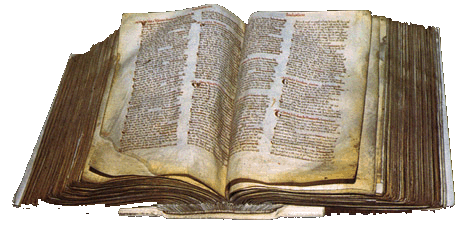
Domesday Book


Image result for UK national archieves domesday bookThe Domesday Book is a type of census commissioned and collected during the late eleventh century by King William I, William the Conqueror. This is Europe's earliest census record. It contains details about livestock and land ownerships throughout Britain at the time of King William I's rule. This census was completed in just nine months after its commission in 1086.Though it is said to be a census of all of Britain many places seem to be left out due to size, or private ownership such as London, Winchester, and County Durham. Other's were not yet conquered like Northumberland, Westmorland and Cumberland. Some others have no explanation. There are actually two volumes of the Domesday Book, Great Domesday and Little Domesday. Great Domesday was written first and Little Domesday was written later, but is more comprehensive.

The Domesday Book was created with parchment. Parchment is made from animal skins. To complete the Domesday Book, between 500 and 800 sheep were used.

Many question the motivation of William I's motivation to call for such a comprehensive census. Some believe it was a display of the strength of his rule. Others argue that is was for economic reasons. Some suggest that he wanted to keep track of what was owed to him by the people he redistributed land to in his conquering. Some others still guess that is could have been a preparation for ware against the Danes and Norway. This would provide him with accurate statistics of Britain resources he could call upon should war occur.

Image result for UK national archieves domesday bookThe Domesday book has a very ominous ring to it despite the actual content of the book. This name occurred because of the all encompassing nature of the book and initial commentary on its observing of all the livestock, people and land in Britain that eerily sounded like end times scripture in the Christian Bible. This book has been used throughout the centuries in Britain as a source of legal justification and genealogy research along with an understanding of the workings of the feudal system at the time. The last known use for legal land ownership reasons was in the 1960's. Despite its obvious usefulness, it is full of holes in representation and human errors. This book is truly a monument to the abilities and resources of King William I and will always provide us a glimpse into the history of Britain.

References:

             Newman, Simon. "The Domesday Book." The Finer Times: War, Crime and History Resource. N.p., n.d. Web. 01 Oct. 2016. <http://www.thefinertimes.com/Middle-Ages/the-domesday-book.html>.  Domesday Book

Image:
These images are of the Domesday Book. These images are taken from the National Archives, Kew, London. Image of Domesday Book

A Festival of Fallacy

There is a time each year when my true self is revealed. I break out the drinking horn and the elf ears and travel back to a time long before our own. That time is vaguely medieval and the place is the Kansas City Renaissance Festival. Yes, it is true that renaissance is in the name, but the festival is truly an amalgamation of medieval, renaissance, and modern day elements.


At the entrance to the festival. See 'medieval' structures in background. The photographer is my mom. (Thanks, mom!) 
A trip to the renaissance festival is an interesting study from a the perspective of a medieval historian because it incorporates elements of both fact and fantasy. Truly, the facts are dubious, but amusing to examine none-the-less.  

The festival includes shopping, eating, atmosphere, and live performances. Each year there is a bird show that includes trained hawks! The hawks don't do any hunting at the festival, but if that isn't an appropriate tribute to the middle ages then I don't know what is.  

My favorite show and the only way to end a day at the festival, in my opinion, is with a joust to the death. In a traditional battle of good versus evil two knights square off. One knight fights for the honor of the king the other fights because he is...evil? But in this seemingly simple character development one can draw connections to Song of Roland. As in the song one character is good and others are bad without much motivation. Perhaps the writers of the joust are more medieval than they know. Ultimately, good triumphs over evil but not before lances are shattered and swords clash and a blood pack explodes. Comparing the joust with the description in the Newman text the similarities are few. As Newman says the joust is a duel between two opponents. However, there seemed to be no clear scoring or points system. Several lances were shattered as spectacle, but the ultimate goal was death. The knights in this joust were not playing for sport unlike the tournaments which Newman describes. 

The festival also incorporates the fantasy elements that are often associated with the medieval world. This includes faeries, mermaids, magic, and a unicorn.

Me and an extremely real unicorn. Photo courtesy of mom. 

The festival even includes pop culture references to the middle ages. This includes Robin Hood characters, characters from Vikings, and a replica of the Iron Throne from Game of Thrones.

Savoring a moment on the Iron Throne.  
The renaissance festival is not historically accurate and it draws on overused tropes, but it does not frame the medieval period as the dark ages. It is a celebration of feasting, fighting, and fantasy that, despite inaccuracies, greatly appeals to the modern public (myself especially). This year it was interesting studying the festival with medievalist eyes. 

And there are still a few weekends left for those interested in doing some 'studying' of their own!! 

 http://www.kcrenfest.com/ 

Works cited. 
Newman, Paul B. Daily Life in the Middle Ages. Jefferson, NC: McFarland, 2001. Print.

Medieval University

Medieval University

Italy, 1400

Italy, 1400

900s, Jewelled crown

900s, Jewelled crown