Historical artifacts from the Middle Ages. Vivid, colorful, and illuminating the past. Here we analyze objects, artifacts, monuments, relics, and material culture as a response to the numerous myths that circulate 'fake news' about the Middle Ages--from their belief in the flat earth (fake!) to the female lock-n-key chastity belts (fake!). In addition, this site will highlight medieval films in all their attempted history (for better or worse). Let's get medieval.
The area that comprised the Smithfield Market had been in continuous use since the tenth century. Smithfield market is Britain's oldest meat marketplace and has been a hub of economic exchange throughout London's history. The Smithfield Market, since the twelfth century, has been the sight of massive trading in meat, livestock and other agricultural goods. The Smithfield Market helped London to become the nucleus of trade in England and a hub for agricultural exchange in the region. Originally the area that would become Smithfield Market was a livestock market on the outskirts of London that traded in everything from cattle, horses, swine, and even poultry. By the twelfth century Smithfield Market had begun to sell meat and not just livestock.
Livestock from all over England would be brought to the Smithfield Market to be traded and bought and sold. By the twelfth century the market place was described as a place where animals of all kinds, especially cattle and horses, could be bought and sold. The site was even used to host fairs and festivals from time to time. The modern Smithfield Market does not sit on the same land that the original did. Due to the expansion of London's residential areas into the former outskirts of the city where the Market was located. The Smithfield Market was moved to the site where it still sits as the largest meat marketplace in all of Britain.
Sources
Rottenberg, Simon. "Monopoly in the Labor Market: The "Bummarees" of London's Wholesale Meat Market" ILR Review, vol. 13, no. 1, October 1956, pp.54-63,http://www.jstor.org/stable/2519493
Porter, Roy. London: A Social History. Penguin Books, 1996.
For those unfamiliar with the comedy style of Monty Python,
a step into their world can be seen as strange and peculiar. The group is best
known for their ability to satirize just about anything they chose at the time.
One could think of their comedy as a giant, “what if?” where people and things
are put out of context to show their truly perplexing qualities. Most notably
on their television series, the group would frame absurd sketches like
questioning what would happen if Hitler escaped to England, changed his name,
and lived like a typical English-person? Awkward, and sometimes uncomfortable, scenarios
like this are the specialty of the comedians of Monty Python and they take this
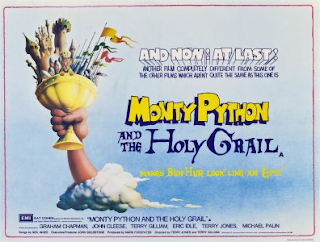
unique comedy into their classic 1975 film Monty
Python and the Holy Grail.
The film is set up to share qualities with famous medieval
epics, like The Song of Roland, which
instantly is noticeable with the inclusion of the heroes of the movies, King
Arthur and his Knights of the Round Table. Along with the legendary characters in
the story the movie includes, like Bennett alludes to, an adventure of epic proportions,
blood and gore, and characters able to survive their mortal injuries (which
becomes a running gag throughout the movie) (283). The movie has many memorable
scenes like these including, the black knight, whose limbs are all cut off but
yet he is still ready and willing to fight (hopefully this is reminiscent of The Song of Roland).
What the film does well in this epic-like styling is ask,
what if medieval knights, who supposedly have these legendary traits and abilities,
are not that legendary nor epic and instead flawed humans? In this context, viewers
can begin to think about their preconceptions of the medieval period and see
how some of the preconceptions are a little embellished. Like how Arthur and
his Knights towards the end of their quest, fail to defeat a small but
ferocious bunny, which kills most of the group, in close combat.
Although, not entirely accurate for historical purposes, the
film does hit upon some truths about medieval life while greatly exaggerating most
other aspects. The film’s main story features King Arthur and his Knights, who
are called by God to go and search for a holy relic that is revealed to be the
Holy Grail. The combination of religion and the ruling powers of a kingdom were
an important part of medieval governance since Charlemagne. Furthermore, kings did
include some religious aspects to their territorial expansion and conquests. Religion,
especially Christianity, shapes the characters in the film and their
adventures. This includes one knight named, Sir Galahad the Chaste, whose encounter
with a castle that is only inhabited by women leads him to desire to be less
than his name before being rescued by his fellow knights. For the most part,
the mail that the knights wore showed how knights were still able to move even
with heavy armor on.
The greatest historical fault to the movie was that many
things were just put in the wrong time periods, for instance many knights have
barrel helmets which did not appear until the 12th century. However,
I do not think the writers were going for the most accurate portrayal of the medieval
period because the point of the film was to satirize people’s preconceived notions
of knights and medieval life, by making it seem over-the-top and humanizing
medieval people.
References:
Bennett, Judith M. Medieval Europe: A Short History.
McGraw-Hill, 2011
Monty Python and the Holy Grail. Terry Gillam and Terry
Jones. EMI Films, 1975
Newman, Paul B. Daily Life in the Middle Ages. McFarland,
2001
The influence of the Middle Ages is not only still being seen today in Western media, it is also reaching a broader, international audience. The stories and their characters (both historic and fictional) of chivalry and knightly conduct are taking hold in the minds of non-Western authors. What more iconic representation of the Middle Ages is there than the legacy of King Arthur and his pursuit of the Holy Grail?
Also, (minor) spoilers ahead. Fate/Zero (aired 2011-2012) is a Japanese animated series (or anime) that takes place in modern day Japan and details the events of the Third Holy Grail War. The fantastical elements come from the existence of 7 mages and their summoning of 7 heroic figures from history in a fight to the death for an all-powerful Holy Grail. The goal for everyone involved is to attain the Holy Grail and have it grant the winner of the battle royale a limitless wish.
Victory and access to unlimited power, or death. Suffice to say, Fate/Zero is a dark fantasy
In terms of relating this to medieval history and the themes of chivalry and knighthood, this 26 episode show is rife with examples, far too much for this small blog post. Instead, there is a single scene that best encapsulates the position King Arthur has in the story for the majority of its run. It begins in our introduction to King Arthur in this scene:
The summoning of heroes is rather reminiscent of the oaths vassals and lords would make with each other to establish their relationship. In this case, it is the master (Lord) paying homage to their vassal (Servant) in order to request their help. Each hero is summoned on a summoning circle while making an oath on a relic deeply attached to their legends, or even their physical corpse. One of the rituals even takes place in a church, which I will point out in a minute perfectly matches which hero is summoned there. The curious inversion expectation is this: Masters are making vassals out of some of the greatest kings and knights of history.
The heroes we see summoned in this scene, in order of appearance: Alexander the Great, Lancelot, Gilgamesh, and, finally,
King Arthur (seen in this picture with Excalibur). Yes, King Arthur is a woman in this story, with the justification that she hid her gender after pulling the sword from the stone in order to be King of Britain. To differentiate this King Arthur from the traditional version., I will use the show's name for her, Saber.
Also, yes, you did read correctly: Lancelot is another hero fighting in this war for the Holy Grail. Saber and Lancelot (referred to as Berserker in the show) have entire subplot dense with themes and references to the legends of King Arthur that also builds and develops Saber's character. Unfortunately, you're going to have to watch the show to find that out, because I want to hone in on one scene in particular.
This scene is called the Banquet of Kings, and it takes place in episode 11 of season 1. It is a conversation Gilgamesh (Archer in this scene), Alexander the Great (called Iskander), and Saber have concerning who should possess the Holy Grail and, by extension, what it means to be king. Here we have the ancient world and its ancient, mythical kings talking with a medieval king steeped in the ideals of chivalry. Unfortunately there is not a clip of just this scene on youtube with English subtitles, so if you would like to view it, go to this link and watch from 1:55-13:45.
Saber questioning Alexander's right to conquer
What we have here are three arguments on what it means to be king, with the focus being on who is worthy to possess the Holy Grail. Gilgamesh's argument is the simplest: He does not want the Holy Grail for its power. Instead, because he claims that all treasures of humanity can be traced to him and his treasury, the fact that the Holy Grail is a treasure makes it his. This is due to a law he made as king, and by kingly right he can punish all those looking to claim the Holy Grail and use its power as thieves that have stolen from his hoard. Basically, a king is who has the might and wealth to both make and enforce the laws of their choosing.
The conflict between medieval and ancient sensibilities comes to a head between Alexander the Great and Saber. For Alexander, kings should be beyond all extremes, beyond good and evil, act out their desires and emotions to a level far surpassing that of a normal person. Kings should be larger than life in every possible way, and should make his followers long to both be like the king and to serve him. Kings are tyrants, he argues, and thus are heroes for their conquest and tyranny.
Saber represents the chivalric knight, a king who acts to bring salvation to Britain. She blames herself for her mistakes and the tragedy that led to the rebellion of her knights, and she pursues the Grail to erase herself from history. Not only is she willing to sacrifice her life for her kingdom, to give up living for one's self in order to alleviate the pains for her suffering people, she sees this as the honorable and essential aspect of being a King.
Alexander and Gilgamesh both disagree, and Alexander tackles the idea of chivalry with this sentiment: Saber is trapped in an ideal that kings exist for others, not himself. The ideal that knights serve the people, serve their lords, serve their kingdoms, when in reality every king became king through their selfishness and greed. It is Saber's failure to lead her people, to show them how to act like a king and give them the desire to serve her, that created the lack of faith in her that led to her kingdom's destruction.
In short: Saber's ideals were her downfall and made her a failure as a king. By extension, she is not worthy of possessing the Holy Grail. In the eyes of the ancients, a medieval king inspired by ideas of honor and chivalry is a naive fool.
Naive, yet brutal and violent.
This inferiority of medieval kings in comparison to the ancients is both a modern medievalism as well as an insecurity realized during the era. Kings would appeal to the authority of the ancients (particularly Rome) to strengthen their own claims to power. The Church would claim that they were the new protectors of Rome and the descendents of the old Roman Emperors in authority. So for a pair of kings seen as even greater than the emperors of Rome, the first true king in Gilgamesh and Alexander the Great, for them to denounce Saber's chivalric ideals is telling.
Again we have a piece of media implying that the Middle Ages is inferior to the ancient world, that for all its ideals it is but a naive child trying to imitate the power of ancient kings. The fact that this perspective is reaching an international understanding shows how influential this idea has become. Looking at the Middle Ages get examined and reinterpreted through the use of its characters in media is fascinating, and if you want more of this introspective look on King Arthur, then the rest of Fate/Zero is right for you!
Before this class, I had heard of Monty Python and The Holy Grail but never seen it. It is now among my favorite movies. It's hilarious, and entertaining, however not at all historically accurate. Long before even finishing the movie, I had plenty of material to write this post. Monty Python and The Holy Grail is a tale of King Arthur of Britain, and several knights (referred to as The Knights of The Round Table) and their quest to find the Holy Grail. Along the way, they encounter many quests, including The Black Knight, a three-headed giant, The Knights Who Say (insert annoying word/phrase here) that are in desperate need of some shrubbery, The Castle Anthrax, and a handful of rude Frenchmen. This story allegedly takes place in the 10th century, "932 AD," as stated in the film.
This movie, like most others about the Middle Ages, really accentuates the horror and gore of the Middle Ages. In the beginning of the movie, a man was wandering through a village hollering, "Bring out your dead!" And the people of the village crawled out of baskets that were lying in the street, and brought their dead (and by dead, I mean their family members who had died that week) to the man who threw them on a platform. One villager brought out a man whom he was trying to pass off as dead, but he was very much still alive. The man who was collecting the bodies knocked him over the head with a club, and threw him in with the rest. This would never actually have happened.
The first problem King Arthur and The Knights of The Round Table encounter is The Black Knight. Really, nothing happens here except the knight is persistent on not letting any one pass, so much so that he is willing to fight after losing both arms and a leg. Hopefully I don't have to tell you how inaccurate that is. Here, what I saw that was problematic as far as historical accuracy, was The Black Knight's armor. His helmet was large and cylinder-shaped. (Picture included below) This was not at all what a knights gear would have looked like in the Middle Ages. They also used a mace to fight in some scenes, which while those were medieval, they weren't used until the 12th century, nearly 200 years after this story. Castles were also mentioned frequently, and those weren't popularized until the 11th century.
Finally, I noticed in one scene, (my favorite scene actually) King Arthur comes upon a witch trial. Three men thrusted a woman up on a platform, dressed as a stereotypical "witch," but then they do admit that they dressed her that way. Through a series of questions conducted, it was decided that a witch burns because she is made of wood, and wood floats, so if the woman weighed the same as a duck than she must be a witch. (I know, right?) While this was all well and humorous, witch trials didn't even happen until much much later, around the 1600's.
Don't lose hope in Monty Python yet, though! Okay, well maybe you can, but some of the aspects in the movie were based off real, true things. For example, in one scene, a song is sung about how one of the Knights of The Round table was so brave that he wasn't afraid to die even the most awful, excruciating death. This reflects beliefs that were real in the time period that the braver a knight was, the better. Another thing that was loosely accurate in the movie, was we were shown a flash of a monastery at one point, and the monks appeared to be chanting, which is also something that might have actually happened, monks often chanted what was called a Gregorian chant. In the same breath, though, they are hitting themselves over the head with planks of wood, which was significantly less likely. The Monks were indeed disciplined but, according to our Bennett book, they wouldn't waste time hitting themselves over the head when they could be reading, working in the fields, or copying manuscripts. While Monty Python is an amazing movie that I insist everyone watches- if you're looking for historical accuracy, well, keep looking.
Bennett, Judith M. Medieval Europe: a Short History. McGraw-Hill, 2011. Gilliam, Terry, et al. Monty Python and the Holy Grail. Columbia Tristar Home Entertainment, 2002.
Medieval Times is a great idea for a night out. You can take the whole family for a night of clean and wholesome archaic fun. While they advertise Medieval Times as an authentic experience, its really not. Yes there was jousting at tournaments, but far more violent then those we see today. Often times the knights would go at each other with a variety of different weapons ranging from axes and maces to pikestaffs. Often times jousting would result in really bad injuries, even death. In real tournaments there were many more ways to entertain oneself. You could watch the melee or the archery competition. Medieval Times just can't match the scope of the tournaments yore.
Another less than realistic aspect pet of Medieval Times is the menu. Tomatoes and potatoes were not brought to Europe until the late 16th century, this rules out the bisques and fried potatoes you receive in your entree. Baked goods would also be replaced fruits and nuts for dessert. Another way Medieval times gets it wrong is in the blandness. If you order a meal don't expect a 5 star taste. The people in the kitchens purposefully make the food taste bland to add to the "realistic" experience. This couldn't be farther from the truth. Food in the middle ages was spiced, spiced, and over spiced. This was too masque the flavor of spoiled meat.
From personal experience, I can say Medieval Times is a great way to spend a Friday night. You get to experience what a small part of it was like to be a commoner in the Middle ages, minus the disease and death of course.
Works Cited
Blitz, Matt. "How Accurate Is A Night At Medieval Times?." Food & Wine, 22 June 2017, www.foodandwine.com/fwx/food/what-medieval-times-gets-wrong-and-what-it-gets-right. Accessed 4 Oct. 2017.
Cybulskie, Danièle. "The Medieval Tournament: Swords and Swordfish." medievalists.net, MEDIEVALISTS.NET, 4 June 2015. Accessed 4 Oct. 2017.
The movie Kingdom of Heaven, released in 2005 and directed by Ridley Scott, features Balian of Ibelin and his defense of Jerusalem and the events that led up to the Third Crusade. Within this movie there are many historical errors and it is more focused on drama for the sake of entertainment than historical accuracy. The movie begins with Balian as a recently widowed blacksmith in a sleepy French village. He is approached by his father Godfrey the Baron of Ibelin who asks Balian to come with him back to the Holy Land. Balian initially refuses but has a change of heart after killing a priest who desecrated the body of Balian's deceased wife. However before they can leave the region they are attacked by the men of the local lord who obviously wants justice for the priest that was killed. Godfrey, his men, and Balian are able to fight the lords men off but not before Godfrey takes a mortal wound.
The party travel to Italy where Godfrey dies but not before having Balian knighted and proclaimed the Baron of Ibelin. On the perilous ship ride over the Mediterranean to the Holy Land Balian is shipwrecked and has to make his way to Jerusalem on foot but not before he slays what he believes to be an Muslim noble and frees the man's slave after he reaches Jerusalem. Upon arriving in Jerusalem Balian is identified as Godfrey's son and after making introductions with some of the nobility in the city like the leper King of Jerusalem, the King's sister Sybilla, and the noble Tiberius, Balian departs for Ibelin. Upon reaching Ibelin our hero swiftly attempts to improve it with public works and agricultural improvements and before long he begins an affair with the King's married sister Sybilla who was visiting Ibelin.
This idyllic time is smashed however by news that Saladin is marching upon the castle Kerak as its Lord, Raynald of Châtillon, had been raiding Muslim convoys. Balian attacks the cavalry vanguard of Saladin's army and his outnumbered knights are defeated. Upon being captured Balian realizes that the slave whose master he killed after he was shipwrecked was actually the noble all this time and the leader of the troops Balian fought. The King of Jerusalem arrives at this moment with his army and manages to make a peace with Saladin and Raynald of Châtillon is imprisoned. The effort of traveling with his army is too taxing for the frail leper King however and before long he dies from the effort. At this point Sybilla's husband, Guy Guy de Lusignan becomes king and he attempts to have Balian killed. Guy is an associate of Raynald of Châtillon and also desires war. Guy, against Balian's advise marches against Saladin and is utterly defeated. At this point it is up to our hero Balian to defend the city of Jerusalem from Saladin's army.
At this point Balian is shown fighting heroically upon the walls and battlements of Jerusalem as Saladin throws waves and waves of his men at the city. Upon seeing the indecisiveness of the battle, Saladin and Balian agree to terms for the surrender of Jerusalem in which the entirety of its population will be allowed safe conduct to Christian lands. At this point Balian returns with Sybilla to the French village from which he originally came and he refuses an offer from King Richard the Lionheart to embark on the Third Crusade, instead deciding that he would rather live a simple life as a blacksmith with Sybilla in the village.
This movie paints the capture of Jerusalem and the events preceding it in a very different light than the contemporaries of this event would have likely seen it. The Kingdom of Jerusalem is portrayed as cosmopolitan, diverse, and a place where different faiths live in harmony and this open mindedness is all the work of the crusaders who rule Holy Land. This differs from the stated aims of taking Jerusalem and the Holy Land back from the Muslims for the Christians. This film introduces concepts into the time period that seem distinctly modern and western. Ibelin is also depicted as a religiously diverse utopia and its portrayal is relatively hard to believe. The film does however explore the idea that the crusades could serve the purpose of wiping away one's sins and perhaps those of people they are close too as this is a primary motivator for Balian as he tries to cleanse his own sins for killing the priest and the sins of his wife, namely her suicide. Although this whole story line is made up and not historically accurate.
The movie presents the antagonist, Saladin, in a measured and favorable way. He is shown as pragmatic and initially resistant to the calls of war from people on his side of the conflict. He is depicted as a clever military campaigner and respectful to the Frankish crusaders who he defeats. He is also seen as quite religiously tolerant and by respecting a cross after the capture of Jerusalem and treats the defeated crusaders much better than the defeated Muslims were after the capture of Jerusalem in the first crusade when the crusaders captured the city. Overall the movie entertains and tries to capture some of the ideological themes that were occurring at the time but it fails in its accuracy and presents events completely contrived for drama that did not occur and creates an imaginary set of events over historical fact.
References
Alberth, John. "Reviewed Work: Kingdom of Heaven" reviewed work Kingdom of Heaven, directed by Ridley Scott, The American Historical Review, October 2005, pp, 1235-1236. http://www.jstor.org/stable/10.1086/ahr.110.4.1235