Lady and the Unicorn

For sharp eyed viewers of the Harry Potter movies, you might notice that the walls of the Gryffindor common room are covered in a bright red tapestry prominently featuring several women, and unicorns. what viewers may not know, is that it is based on a real set of tapestries from around 1500 called "the Lady and the Unicorn"
The family that commissioned it were from Lyon, France it is not known who exactly designed it, yet it is considered by some to be the Mona Lisa of the medieval era, because of it's complexity and beauty. It consists of 6 panels, each representing the five senses, Taste, Touch, Sight, Sound, Scent, and the sixth sense Desire.
It features many aspects of medieval mythology and symbolism, such as the unicorn, which may have represented courtly love. as well as s Fox, Rabbit, Genet, falcon and Heron which represent nobility, (just to name a few.)
The panels were only recovered in 1814 in Boussac Castle in Creuse and became position of the French Government in 1882
Works Cited
- Delaney, Brigid. “Lady and the Unicorn: Mona Lisa of the Middle Ages Weaves a New Spell.” The Guardian, Guardian News and Media, 13 Feb. 2018, www.theguardian.com/artanddesign/2018/feb/13/lady-and-the-unicorn-mona-lisa-of-the-middle-ages-weaves-a-new-spell. 
“- The ‘Mona Lisa’ of Medieval Art.” Medievalists.net, 14 Apr. 2018, www.medievalists.net/2017/04/mona-lisa-medieval-art/.

A Crusader Hospital

Image result for knights hospitaller symbol

Although the Knights Templar is the most recognized type of knight to exist during the Crusades, they are far from being the only type. The Order of Knights of the Hospital of Saint John of Jerusalem, or the Knights Hospitaller, was a military order whose primary focus was to care for the sick and injured pilgrims traveling to the Holy Land.

In the heart of Jerusalem resides the remnants of a 1,000-year-old hospital building that was constructed by the Knights Hospitaller. The building collapsed in the earthquake of 1457 and was discovered in 2013—13 years after excavation began.  

Spead out over an area of 150,000 square feet, the building's setup is very similar to that of a modern hospital. Wings that were once organized according to medical condition branch off into smaller hallways and patient rooms. The Great Hall areas are characterized by massive pillars and 20-foot ceilings.

The facility is said to have also doubled as an orphanage. In many cases, newborn babies would be dropped off; if a mother had twins, she would deliver one of them to the orphanage. These orphans were very well cared for and raised to become a part of the military order once they were of age.


Works Cited


Bringing Back the Bayeux Tapestry: One Stitch at a Time

Close up of stitching, c. 1070
Only a few years after William the Conqueror's conquest of England in 1066, the famous Battle of Hastings was commemorated in the Bayeux Tapestry. Historians date this piece as completed in 1070 CE, only six years after the Battle of Hastings. Since it's creation, all 75 panels have been a source of awe. The stitchwork itself shows incredible detail in order to tell an incredible story. Notably, the Bayeux Tapestry is not a true tapestry because the images were stitched onto the linen, not into the linen itself. Regardless of the "tapestry-ness" of the piece, the craftsmanship of the Bayeux Tapestry is amazing.

In recent times, people across the world have tried to make copies of the original tapestry, from a scrolling recreating on paper to quilted reimaginings of the original story, each new rendition maintains the grandeur of the original.

One of the most widely distributed recreations is on mica-coated paper which allows for the impersonation of stitches. The paper itself is about 43 meters (about 141 feet) and encased in a table with a glass top to enable viewing. Printed and produced by The Folio Society in England, their hope in making all 480 recreations is that they would be put in libraries and schools to encourage a closeness of English history to the modern day.

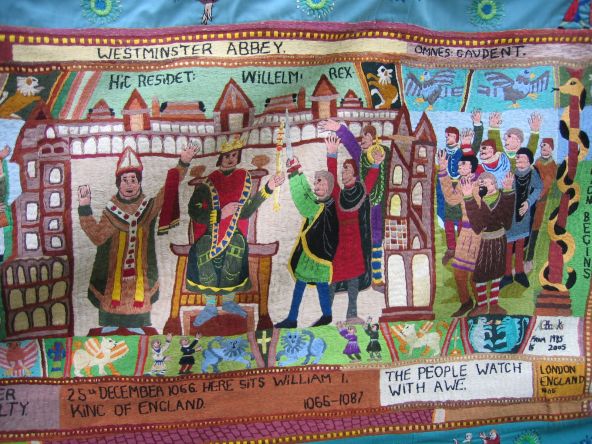
Bayeux Tapestry by Annette Banks, William is crowned King of England
Another recreation of the Bayeux Tapestry exists in a very colorful and quilted form, done by Annette Banks in the early 2000s. Banks was diagnosed with hyperactivity and Cushing's Syndrome, which stunted her life expectancy. However, with a passion for English history and a talent in sewing and stitching, Banks was encouraged by her father to recreate the famous tapestry. Her final work was around 51 feet long and much brighter than the original. Pictured to the right is Banks' recreation of the Bayeux Tapestry.


References:

Beardsley, Eleanor. “Reviving the Rich Legacy of the Bayeux Tapestry.” NPR, NPR, 26 Dec. 2005, www.npr.org/templates/story/story.php?storyId=5069696.

Gladstone, Richard. “Recreation of Famous Bayeux Tapestry.” News, Rye & Battle Observer, 2 June 2017, www.ryeandbattleobserver.co.uk/news/recreation-of-famous-bayeux-tapestry-1-7990381.

Shearing, Sue. “Woman Recreates Bayeux Tapestry in 20 Year Bid to Beat Hyperactivity.” Daily Mail Online, Associated Newspapers, 29 Nov. 2006, www.dailymail.co.uk/news/article-419494/Woman-recreates-Bayeux-tapestry-20-year-bid-beat-hyperactivity.html.

Tanton, Kristine. “The Bayeux Tapestry.” Khan Academy, Khan Academy, 2018, www.khanacademy.org/humanities/ap-art-history/early-europe-and-colonial-americas/medieval-europe-islamic-world/a/bayeux-tapestry.



The Tomb of William the Conqueror


William the Conqueror had a complicated life when it came to love. In 1051, Pope Leo IX disapproved of his marriage to Matilda of Flanders. It is theorized that this was because of their "excessively close kinship" as fifth cousins, or second marriages of Matilda's parents that would invalidate her heritage. Leo's successor, Nicholas II, pardoned their marriage as long as they built two abbeys and four hospitals. Matilda commissioned the Abbey of Sainte-Trinité, and William Saint-Etienne.


The Abbey of Saint-Etienne, also known as the Mens' Abbey or Abbaye aux Hommes, was founded in 1063 and consecrated in 1077. Its structure served as the model for Norman abbeys in England. The exterior is Romanesque and spans three levels, with two symmetric towers marking the original point of entry.

William was buried in the choir of the abbey in 1087. A little beloved ruler, his body was held in Rouen, France, for three weeks before it was transported to its resting place at Caen. The corpse was bloated from heat and the king's late gluttony and burst when it was lowered into the grave. The grave marker, placed in the nineteenth century, is written in Latin and reads, "Here lies the invincible William the Conqueror, Duke of Normandy and King of England, founder of this edifice, deceased in 1087."

The original monastery was destroyed in religious wars of 1562 and 1563, though the church still stands with its eleventh century architecture. The choir was remodeled in the fifteenth century in the Gothic style. Because the tomb was opened and vandalised several times, all that remains of William the Conqueror is a thigh bone.


Works Cited

"The Men's Abbey." The Epic Adventure: In the Footsteps of William the Conqueror. Calvados Tourist Board, 2018.  http://william-the-conqueror.co.uk/the-mens-abbey/.

Serena, Katie. "Gross! William the Conqueror's Body Exploded on People at His Funeral." All That's Interesting, 1 December 2017. Updated 13 July 2018. https://allthatsinteresting.com/william-the-conqueror.

Douglas, David C. "William the Conqueror: The Norman Impact Upon England," Appendix C. University of California Press, 1967. Retrieved from Erenow.com. https://erenow.com/biographies/william-the-conqueror-the-norman-impact-upon-england/21.html.

Doom's Day: How a Census Bolstered Royal Power

After the defeat of King Harold II at the Battle of Hastings, William the Conqueror's reign over the kingdom of England was one of peace and serenity... right? Not exactly. In 1085, nineteen years after William's own invasion, the Danes were at his door. To better prepare for the Danish attack, William commissioned the Domesday Book -- an early census containing information on the resources and taxable items held by all the manors in England.


The Domesday Book stands as a testament to the significant expansion of the royal administration, and bears evidence to William's consolidation of royal authority. The record allowed William to see which lord owned what, how much it was worth, and how much each lord owed him in taxes and military services. By recording such details, William was able to recover his royal rights and maximize revenues and military conscription. Moreover, it eliminated any dissent as the names of the King's barons and churchmen who held lands were also record, thus any attempts to dispute a tax demand where rendered fruitless.


It appears not much as changed, as the people of England, much like some people of today, were not the biggest fans of taxes, hence "Domesday Book." Once called the Winchester or King's Roll, the Domesday Book was granted its current title from the Dialogus de Sacarrio -- a book written about the exchequer in c.1176. With "Domesday" sounding quite similar to "Dooms Day," it is often believed that the title is a metaphor for the day of judgement because, much like the judgement of your soul, its records and decisions were final. 


Words Cited:

Bennet, Judith M. Medieval Europe: A Short History. 11th ed., McGraw-Hill.

National Archives. “Domesday Book - Survey and Making of Domesday.” The National Archives,    The National Archives, 26 Apr. 2017, www.nationalarchives.gov.uk/domesday/discover-domesday/making-of-domesday.htm.

National Archives. “Discover Domesday.” The National Archives, The National Archives, 26 Apr. 2017, www.nationalarchives.gov.uk/domesday/discover-domesday/.


The Unique Find from Silacwine

William the Conqueror (or as known by some as William the Bastard) is mostly remembered as being the first Norman King of England. Although distantly related to King Edward the Confessor (reigning from 1042-1066), he still had a legitimate claim to the throne--and succeeded in taking the crown. He ruled from 1066 until his death in 1087, establishing an aristocratic regime and erecting numerous castles throughout the land, strengthening royal power. He helped transform England into what it is today and is an important figure in the history of the Middle Ages--even being depicted in the famous Bayeux Tapestry with his half-brothers.


Just recently, in 2011, a hammered silver coin was found in England. This find was actually a unique silver penny of William himself dated from around 1077 to 1080. Engraved into the face of the coin are the words "PILLELM X" translating to "William the King" along with his face. On the reverse side is a cross pattée and the words, "[S]ILIACPINC ON GLI" translating to "Silacwine of Gloucester", the name of the moneyer. This amazing discovery was the first and only example of coins minted in Gloucester in that time period and that "the discovery of this coin therefore proves that the mint was in operation throughout the whole reign of William I" ('Unique'). During his reign, William the Conqueror had at least 70 mints producing coins. 
History is once again proven to be fascinating when artifacts like this one are discovered. There are many missing pieces, but when one puzzle gets solved, the picture always turns out to be worth it.


Works Cited:

Bennett, Judith M. Medieval Europe: A Short History. McGraw-Hill, 2011.

'Unique' 11th Century coin discovered near Gloucester

Unique William the Conqueror silver penny found


Medieval University

Medieval University

Italy, 1400

Italy, 1400

900s, Jewelled crown

900s, Jewelled crown