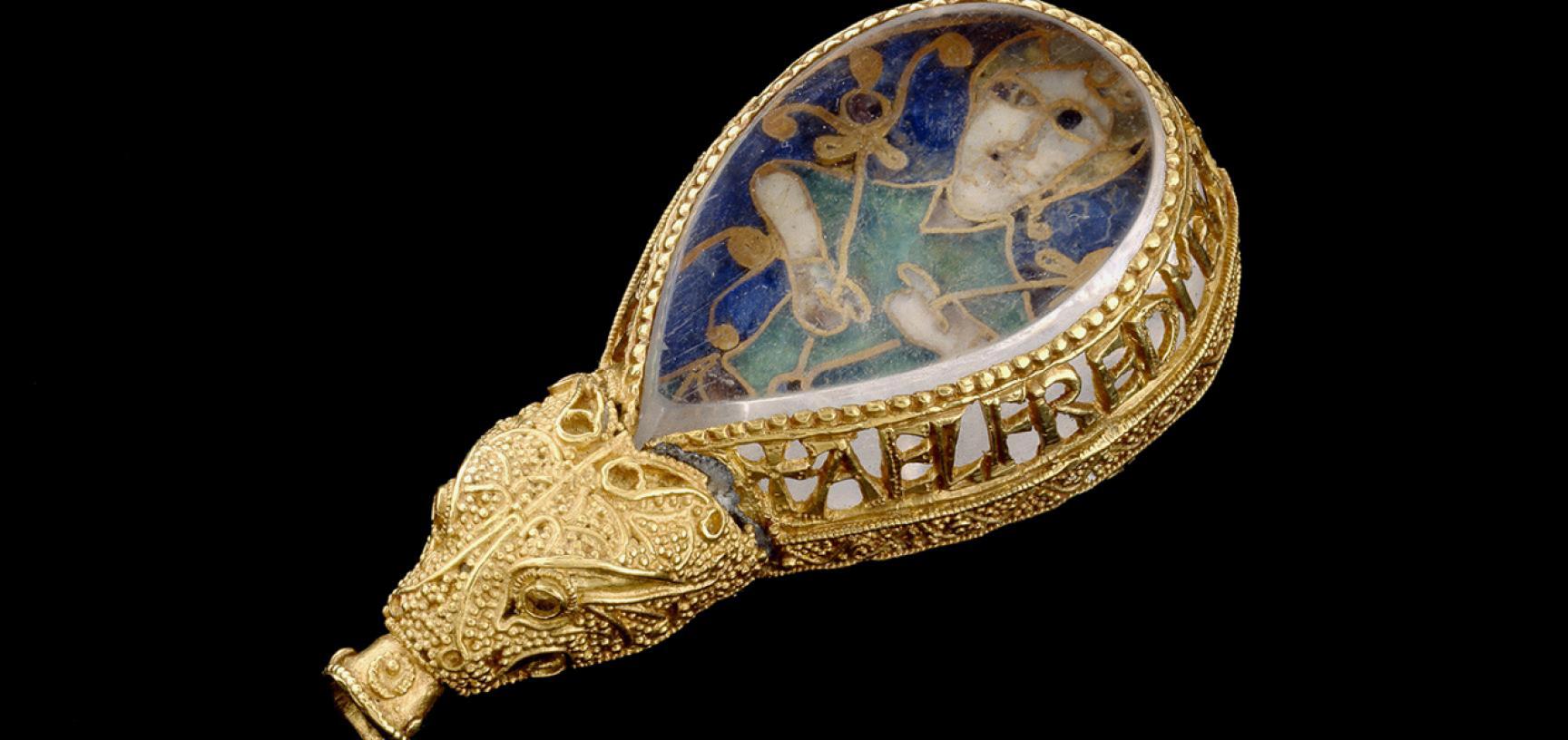
The Alfred Jewel


The Alfred JewelImage result for the alfred jewel

The Alfred Jewel is a gold reading pointer formed around a tear shaped rock crystal.  This magnificent artifact was discovered in a field a field a few miles away from King Alfred the Great's  fortress and monastery at North Petherton, Somerset in 1693 while being plowed. The location this artifact was found at is believed to be where King Alfred the Great had his counter-attack on the Great Army of the Vikings, which led to his much needed military victory at Edington in 878 and the expansion of his authority across the southern half of England. 

One of the most significant details besides the intricate complexity of the gold work is the artifact is it is inscripted with the phrase "AELFRED MEC HEHT GEWYRCAN" along the side, translating out to "Alfred ordered me to be made".  Also, the dragon like head at the base of the jewel holds in its mouth a  socket which was used to hold the actual pointer (missing) that might've been made from ivory or wood. The figure found on the top layer of the rock crystal is said to represent the sense of sight, perfect for expressing on one's commitment to christian learning. Some manuscripts like the Alfred  Jewel were distributed throughout King Alfred's kingdom as pointers used to follow along text to help ones reading. 

Source:
“ALFRED JEWEL.” ALFRED JEWEL | Ashmolean Museum, https://www.ashmolean.org/alfred-jewel.
“Alfred Jewel.” The British Library, The British Library, 16 Oct. 2018, https://www.bl.uk/collection-items/alfred-jewel.


Finger Ring with a Cross- Frankish Artifact


 Finger Ring with a Cross

Throughout the Middle Ages, finger rings were common among those who were of higher rank. Some rings of the ages had monograms and names crafted into the metalwork were used to seal important documents. However, most rings were used and seen as accessories to add to already opulent apparel. Like most jewelry of the time, rings were made from gold, as well as sometimes silver. They were crafted with different precious stones such as amber and emeralds. Many different metalworking techniques were used for jewelry during the time as well.

This ring specifically is Frankish, originating from France between 450- 525 C.E. The ring most likely belonged to a Frank that was of a high ranking and was worn as decoration as well as to represent the wearer's Christian faith. The fine craftsmanship of the ring helps to demonstrate the sophistication of the Franks when it came to metalwork. The intricate spirals of metal and the use of the garnet and mother-of-pearl add a layer of beauty to the piece as well as to indicate the amount of work the Frankish put into their metalworking for not only rings, but other jewelry and crafts as well. 


Artifact #1- Thor's Hammer Pendant


Thor's Hammer Pendant 

     The Thor that we are all familiar with today does not quite hold truth to the Thor that was familiarized in the Viking-Era. He was in fact son of Oden and temperamental thunder-god; however, his physical image was more or less skewed for modern pop-culture. According to the Swedish Natural and Cultural History Museum Thor was, "the god of farmers and free people. He is temperamental, with red hair and bushy eyebrows" (Pictured Right). He is also well known for having three key pieces of weaponry that aid him in his quest to defend Asgard: Megingjord, the belt of power that doubles his strength; a pair of iron gloves; and Mjolnir, his ever so famous hammer that hits whatever it's aimed at without fail and returns to his hand like a boomerang. 

     Thor's hammer typically has a grander scheme of uses to viking's and their heirs other than helping Thor guard Asgard. According to historian Hilda Roderick Ellis Davidson, 

      It would seem indeed as though the power of the thunder            god, symbolized by his hammer, extended over all that had        
      to do with the well-being of the community. It covered                
      birth, marriage, and death, burial, and cremation ceremonies, weapons and feasting, 
      traveling, land-taking, and the making of oaths between men. 
      The famous weapon of Thor was not only the symbol of the destructive 
      power of the storm, and of fire from heaven, but also a protection against the 
      forces of evil and violence. Without it Asgard could no longer be guarded against the        
      giants, and men relied on it also to give security and to support the rule of law. 

This summary highlights the uses of the pendant to the viking people and anyone who celebrates viking culture in the modern day. 

     This artifact that I have chosen to talk about is Thor's Hammer pendant that is kept in the gold room of the Stockholm history museum, Historiska Museet (Pictured Above). This piece of precious viking gold was found in one of the many viking-era hoards that get unearthed in the modern world. Thor's hammer was made into pendants that warriors would wear in order to gain protection and strength from Thor himself. This piece helps illuminate the Middle Ages because it symbolized something that was very important to viking culture. It can also be used to preserve the tradition of oral storytelling if you're wearing it and someone asks you what it is or where it came from. You can proudly tell them the story of Thor, Oden, and Asgard that your ancestors held dear to their hearts.


 Sources:
“Gold from Viking Hoards.” Viking Gold, Stockholm , 21 Jan. 2014, http://users.stlcc.edu/mfuller/vikinggold.html

 McCoy, Daniel. “Thor's Hammer.” Norse Mythology for Smart People, 2012, https://norse-mythology.org/symbols/thors-hammer/

“Thor – a Temperamental Thunder-God.” The Swedish History Museum, Historika Museet,  https://historiska.se/norse-mythology/thor-en/ 

Ardagh Chalice


Ardagh Chalice
The Ardagh Chalice is a cup that dates back to the 8th century. The artifact was discovered alongside a hoard of other objects. This find became known as the Ardagh Hoard. The chalice was found by a man looking for potatoes in 1868 in Limerick, Ireland.  It is believed that it was used to distribute the wine for mass.

The cup’s appearance is Roman while the construction is Irish. The chalice is made out of silver and is decorated with gold, glass, and other materials. Beneath the band of gold, the names of St. Paul and eleven apostles can be seen. The Ardagh Chalice is testament to medieval craftmanship. The chalice can be seen at The National Museum of Ireland in Dublin, Ireland.


“   Ardagh-Carrickerry    History.” The Ardagh Chalice, http://limerickdioceseheritage.org/Ardagh/hyArdaghChalice.htm.


Jelling Silver Cup- Viking Artifact

Jelling Silver Cup


This is a depiction of the burial site in which the Jelling cup was found
The Jelling Silver Cup is a Viking artifact that was found in Jelling, Denmark.  The cup was found in the burial mound of who is thought to be Danish King Gorm the Old(c. 936-953. CE).  The cup dates about 953 CE.  The mound was excavated in the 19th century, however, it did not contain many artifacts as it had already been emptied in the Viking Age. 

Jelling Rune Stones in Denmark

     In 975 CE, King Harold Bluetooth proclaimed Christianity as the Dane's new religion on a large rune stone.  The stone was in between two burial mounds at the site in what is now Jelling, Denmark; the North and South Mounds.  It is thought that King Gorm was moved to the church from the North Mound where he was buried after King Harold, his son, proclaimed Christianity.  It is in that North Mound that the Jelling silver cup was discovered.  
The cup is decorated with typical Viking Age style ornamentation.  There are very often animals depicted in the decoration of cups and many other artifacts from this group of people.  The Jelling style was named after this cup.  The Jelling style of ornamentation depicted an animal or beast with a ribbon like body.  Animals are often "S" shaped.  Patterns in this style also often interlaced.  The Jelling silver cup can be found at the National Museum of Denmark today. 

“Viking Age Jelling Cup.” Ancient History Encyclopedia, Ancient History Encyclopedia, https://www.ancient.eu/image/9347/viking-age-jelling-cup/.
“Viking Art: The Six Art Styles.” History, 29 May 2018, https://www.historyonthenet.com/viking-art.

Beowulf (2007)

The 2007 movie “Beowulf” is loosely based on the medieval ages. The movie contains many magical creatures and items that definitely did not exist. These elements also make up a large portion of the movie, making the movie very fictitious. Even with all the fantastical elements found in this movie, there are still many ties to actual events from the middle ages.
One of the most accurate portrayals within this film is the rise of Christianity. At the beginning of the film, Christianity is only mentioned by one person and is immediately dismissed. After the time skip, Christianity is mentioned by multiple people and is not dismissed at all, but other gods are still mentioned. With “Beowulf” taking place in modern-day Denmark, the slow introduction of Christianity makes sense. This aspect of the film is probably the most useful element to learning about history because it shows the increasing importance of Christianity throughout Europe.
When it comes to the people and kingdoms represented, it ends being up hit or miss. None of the people in the film actually existed, but the tribes they hailed from did exist. Those tribes even lived where they were depicted living in the movie. Along with the people, the kingdom in the movie didn’t exist, but it was still part of a tribe that did exist.
The only other aspects that accurately represent history are the weaponry, clothing, and general viewpoints of people. The rest of the movie was very fantastical in nature. Even the idea of a brave warrior that fights monsters single-handedly, although somewhat existing in that time, is a famous fantasy trope that exists today. 

In conclusion, the 2007 movie “Beowulf” is very historically inaccurate. Even with the few accurate points, they are only small portions of the movie. The movie as a whole is very different from actual events of that time period.

Medieval University

Medieval University

Italy, 1400

Italy, 1400

900s, Jewelled crown

900s, Jewelled crown