Kingdom of Heaven

          The Kingdom of Heaven is a 2005 historical fiction film loosely based on the life of Balian of Ibelin, a crusading French noble in the 12th century. Like most films set in the middle ages, it is riddled with inaccuracies from the start. Many events are blatantly made up and the protagonist only very slightly resembles the Balian of history. While The Kingdom of Heaven portrays several battles relatively accurately and includes a few truths about Balian’s life, it is far too muddled with fiction to be considered historically accurate.
                The plot of The Kingdom of Heaven takes off quickly, with Balian learning of his wife’s suicide and subsequently murdering his half-brother and town priest for decapitating her corpse before burial. Partially out of rage and partially pilgrimage, Balian flees his French village with a band of crusaders heading for the Holy land. True to Hollywood, blood begins flying when the village’s lord ambushes the band of crusaders after discovering the priest’s murderer was among them. The crusaders put up a righteous fight and manage to defeat their attackers, although the crusaders’ leader (later revealed to be Balian’s true father) is killed. Before he dies, however, he knights Balian and makes him promise he will restore holiness in Jerusalem.
Liam Neeson... much better in Non-Stop
                Balian takes on his father’s vision and makes it to the Holy Land relatively unscathed. Soon after arriving, a company of rogue Christian cavalry massacre one of Salah ad-Din’s trade caravan, provoking Salah ad-Din to lay siege to castle Kerek, a strategically important fortress. Balian gathers his band of knights and directly confronts Salah ad-Din, giving the civilians of Kerek time to escape. Needless to say, the entirety of his “army” of less than a hundred is either killed or taken captive. Balian negotiates a diplomatic escape, but the same group of Christians again recklessly antagonizes Salah ad-Din. Low on supplies and short on water, they engage in a confrontation with the Arabian army and are predictably decimated. While this Christian army was led by foolhardy nobles, it was sizeable, well-equipped, and formally trained. This unfortunately leaves Balian as essentially the only commander of a Crusader army.
                Encouraged, Salah ad-Din prepares to finally siege Christian Jerusalem while Balian rushes to the city’s defense. The French knight shows his ability as a tactician by holding off the superior Arabian force for three days, toppling siege towers, defending an unwalled portion of the city, and finally negotiating admirably light surrender conditions when defeat is inevitable.
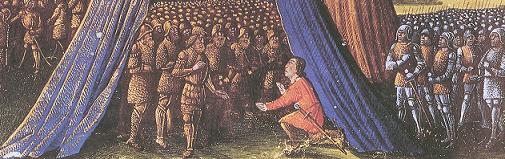
Balian beseaching Salah ad-Din for surrender

               The Christians are to be allowed safe passage to Crusader lands, and Salah ad-Din honors these arrangement. Our protagonist returns to France and the film closes with King Richard the Lionhearted passing through Balian’s home village. The English king requests Balian join him in his march to Holy Crusade, but he refuses, telling Richard he is just a simple blacksmith.
                While The Kingdom of Heaven certainly has a basis in history, most of the plotline is completely fictional. Balian was no common blacksmith, having inherited castle Ibelin and named vassal to his brother Baldwin. Balian, after a series of political skirmishes, became advisor to Guy of Lusignan, ruler of Jerusalem. The initial conflict between the crusaders and Salah ad-Din was indeed started when Guy’s ally Raymond of Chatillon attacked a caravan, but the film depicts Guy and Raymond acting in accordance with one another, when in truth Guy was furious with his ally. Balian actually travelled to Tripoli with the Grand Master of the Knights Templar and Knights Hospitaller to reconcile Raymond with Guy, as opposed to the film’s depiction of Balian heroically leading an outnumbered cavalry charge against the Arabian army to give Raymond enough time to escape. After Salah ad-Din slaughtered most of the Christian embassy, Raymond returned with Balian and the Christian forces coalesced at the city of Sephoria. At this point, history and The Kingdom of Heaven fall out of agreement, save a few small details.
The Christian army led by Guy begins to march across a desolate, uninhabitable wasteland, intending to relieve the siege of the Christian castle of Tiberius and bolster their forces with those at the castle. Unfortunately for the Christians, this is where The Kingdom of Heaven is on par with fact; the army had no water to speak of, very little food, and were relentlessly harassed by Salah ad-Din’s light cavalry. Seeing what they thought was their salvation ahead, a landmark called the Horns of Hattin, the beleaguered Christians made their stand between the two earthen mounds and prepared to fight the full force of Salah ad-Din. 
The Horns of Hattin

The battle that ensued is perhaps one of the greatest defeats in history, leaving nearly every Christian in a pool of their own dehydrated blood and the Arabians scarcely sweating. Salah ad-Din swept across the land and, with victory after victory, reclaimed Christian domain. Balian, who managed to survive the bloodbath, returned to Jerusalem and helped defend the city. In surprising agreement with the film, Salah ad-Din besieged Jerusalem for a time, leveling several walls but never gaining entrance. Balian did indeed negotiate the same surrender as depicted in the film, but the successive event is the most laughable inconstancy of all.

Richard the Lionhearted made his way to the Holy Land, but instead of seeking out Balian as was shown in the film, he vehemently despised the man, saying he was worse than a goblin and he and his wife (in fact, was living) were “steeped in Greek filth from the cradle, she had a husband whose morals matched her own: he was cruel, she was godless; he was faithless, she was fraudulent.” The fact that the directors of The Kingdom of Heaven did not bother to adhere to this last detail draws doubt to the rest of the production, and upon closer examination, it is clear the film is very inaccurate in regards to the majority of events. While the film would be of some limited use in a history class, the professor would be so weary of explaining what was true and what was Hollywood, he/she would likely follow suit of Balian’s wife.                                                                                                                                            

Lost and Found: Templar Edition

In October 2007, the Vatican added a document to the Papal report about the Knights Templar that had been missing for 699 years.  This document which dates back to 1308, is titled Processus Contra Templarios, which translates as “Trial of the Templars”. This Papal manuscript archives the accounts of treason against the Templars, their defense, and Pope Clement V’s absolution order. 
As we learned in class the Knights Templar was a prestigious organization which aided in the Crusades of the 11-13th centuries.  During these Crusades, Christian Armies would travel from Europe to the inhabited Muslim territory in order to take back the Holy Land.  According to this TIME article, in 1187 (which would be during the 3rd Crusade) the Templars lost holding in Jerusalem, which attributed to their loss in credibility.  In 1303, they lost holdings in present day Syria and failed to take Cyprus in 1307.  It was soon after that event King Philip IV of France drew up charges where he had the Templars arrested, tortured in hopes to contain confessions of heresy.  The following year the matter was brought to the Pope. 
The transcripts of this trial had been misplaced in the Vatican archives until 2001.  The official verdict of the trail of the Templars concluded that they were immoral but not heretical.  Dude to outside pressure following the trial, the Pope then disbanded the Templars and gave a majority of their wealth to a rival group. 
Here is a replica of the court transcripts dating from 1308.

The Missing Page...

In 1128, the Council of Troyes approved for a group of religious knights to form under the rule of St. Bernard of Clairvaux. These knights became known as the Templars and they were considered a religious military world order with religious protections (CP 62). The Templars were justified as a warrior of Christ and their job was to make sure evil did not survive. It is believed that in the 14th century, King Phillip IV of France had all of the Templars arrested because of his greed for their wealth.

St. Bernard of Clairvaux
The charges included 127 articles accusing the Templars of various heretical activity. In 1312, the Templars were burned at the stake before they were even put through a legal process. For many centuries, there was no indication that the Templars were anything more than heretics that had no support from the papacy, until 2001. In 2001, Barbara Frale stumbled upon a piece of parchment within the records of the Vatican archives revealing that in 1308 Pope Clement V absolved all of the Templars of their accused heretical activity.

The Templars Burning
This missing parchment is known as The Chinon Parchment, which helped fill in the missing gap between papal support and the Templars. After finding this document, the Processus Contra Templarios was created in 2007. This book includes exact replicas of all the documents regarding the Templars. Sadly only 799 copies were created, but Stanford library has one if you ever decide to transfer there!  

Partial of Processus Contra Templarios
This website contains the document of St. Bernard in support of the Templars: In Praise of the New Knighthood

If you ever think you can afford a copy of the Processus Contra Templarios, here is a link to one on Ebay: Processus Contra Templarios

And the trumpets, they go...

As a trumpet player myself, I was immediately drawn to all the references of trumpets in the Song of Roland.  Seemly used to in the song as a declaration of the start of the battle, and to signal need for help or reinforcement.

Marginalia of a bunny playing the trumpet
Petrus Comestor, Historia scholastica
England c. 1283-1300


  " 'To let my pagans know this [the arrival of Charlemagne], sound your trumpets.'
Throughout the host they beat upon the drums
and sound those horns and brilliant clarions."
-Song of Roland (155-54)


 The first trumpets were made of horn, animal skin, or wood, and resembled nothing of the modern trumpet used today.  Used by the Roman Empire as a signaling device during war, this practice for the most part was not present in the Medieval Ages.  It was not until the crusades until trumpets would reenter medieval military practices.  Clarions, a medieval trumpet with a long bell and no values, was of basic design and could only produce a few distinct pitches.  These trumpets would not be used widely in Charlemagne's time, with instead bugle like horns, such as Roland's oliphant, were much more common.  However, once the trumpet was commonplace in military practices, they were the most guarded person in the troop, for all communication relied on them.  Outside of the military, ceremonies often time featured trumpets, such as the royal welcome that comes to many peoples minds.  It was a great event to hear a trumpet for common folk, as trumpet players were associated with these important events.  Many times a royal standard or flag would hang down from the long neck.
 
The Loud Horn ~ When one man blasts a horn to call William and Norman leaders to the feast before the Battle of Hastings, the servant next to him seems to be displeased at the noise.
Horn in the Bayeux Tapestry.
This was used to call William the Conqueror to dinner, not to battle.
More typical of a wartime "trumpet" used in the Song of Roland.
medieval trumpets
More marginalia, this time showing what
a typical clarion would look like with long bell and flags.
This type was more common among royalty and
ceremonies, not warfare. 
 
 
Fun fact:
Although I could not find any true fanfares from the medieval period, I did run across a renaissance period piece that is suppose to feature military calls and signals of the late Medieval era.  La bataille by ClĂ©ment Janequin was composed in 1515.  Although preformed by a choir, this piece is the earliest know work to incorporate military signals that could have elements of medieval uses of military signaling.  Please take a listen below but keep in mind that this is NOT medieval music but renaissance.  The best part is at 2:32, that section seemed most fanfare and "trumpet-like" to me.
 
 
Sources:


Medieval Devotion in Post-William England (and bed curtains)

The Normans brought a few things to England: ties of vassalage, castles, and manuscript production (in addition to the practice of going totally clean-shaven; those mustaches in the Bayeux Tapestry are Anglo-Saxon). A look through a recently ordered book, The St. Albans Pslater: Painting and Prayer in Medieval England, reminded me of the impact of the Normans on England in terms of religious practices. William saw himself as the head of the church, though he invaded England holding a papal banner. The men that he brought with him replaced many of the abbots. For instance, at St. Alban's Abbey, Paul of Caen (referred to as "dust broom" in primary sources) became the abbot in 1077, right during the midst of the Domesday book inquisition, or inquisitio (that means simply questioning). In addition to the construction of a Romanesque abbey church, St. Albans, he instituted a fully functioning scriptorium where professional scribes rubricated (drew lines), colored beautiful pigments, and copied text. One of the outcomes of the projects is the well-known artifact, The St. Alban's Psalter, which was probably a devotional book for the monks at St. Alban's monastery, but may have been a devotional text for a local  religious woman, Christina of Markyate, who earned fame for her religious life, prophecy, and advice.

The mystery of The St. Alban's Psalter is that a large section was cut out and replaced with an image of Christina. Who was Christina? Born around 1095, we only have the book The Life of Christina of Markyate to tell us, and that was only located in the past hundred years. We know very little except what the life tells us--and for that I like the idea of getting to know a so-called commoner. We know she came from wealthy family from a city and that her dad's name was Autti and the moms' Beatrix. What does this mean? Probably she was the result of an Anglo-Norman "alliance"--if the names are any indication. We also know she pledged herself to God at any early age after visiting local monasteries. This annoyed several people: her parents, her betrothed, and the local bishop who also had a secret crush on her after having had children by her aunt in a concubine arrangement. Christina (a name she chose, meaning "little female Christ") showed massive restraint in surviving many arranged incidents that her parents invented in order to deter her from a life of virginity, including trying to get her drunk and locking the betrothed in her bedroom and basically giving him permission to consummate the marriage in any way possible. Nice job, mom and dad, the parent award for negligence goes to you. Kudos to Christina for hanging on from a curtain rod behind the fabric as they searched her room.  After she was able to resume a religious life, we know she befriended some monks at St. Albans. While we don't know if this psalter was hers definitely (this book seems to suggest we simply don't know), we do know she lived a remarkable life as a woman free from marriage in the post-William era. Her parents life, as an Anglo-Norman marriage, show the interweaving of these two societies together. The monasteries built are a testament to what kinds of possibilities were available, for manuscripts and women who sought the ability not to marry. If you need a later medieval project, for another class, check out the book featured below!
St. Alban's Abbey, England (Romanesque)

The later added replacement initial featuring Christina, note the cut out around the edges in the parchment.

This is a book about Christina--though I've used her Life in an upper level class. 

Bishop Bling

In the 9th and 10th centuries, lay investiture was a great debate in the Medieval world.  The power to chose a new bishop had been under the authority of the Emperor, a layperson not of the Church.  The work of Gregorian Reform, which began with Pope Leo IX and grew to a climax under the pontificate of Pope Gregory VII, worked to end lay control over Church appointments by attacking simony, eliminating clerical marriage, and asserting the Pope's authority over all of Western Europe.

One of the traditions that the papacy attacked through Church reform was the symbolic gifts of the ring and staff given to new appointees by the laypeople.  These represented a marriage to the Church by the ring and the duty of a good shepherd by the staff (also known as a crozier).  This signified a layperson's "investment" into a bishop's office (Bennett, 172).  Under the Concordat of Worms (c. 1122), the bestowing of the ring and staff no longer was a layperson's privilege, since only the pope was allowed to bestow spiritual authority.  The emperor did however retain the power to give territorial and administrative authority to a new bishop, but lay investiture was for the most part over (Bennett, 174). 


Bishop's Ring
13th Century bishop's ring on display at the Walter's Art Museum in Baltimore, Maryland.
http://art.thewalters.org/detail/22345/bishops-ring/


Choirmaster's Crozier with Saints Valerie, Martial, and MichaelCrozier with the Annunciation
13th Century croziers of French origin.  On display at the Walter's Art Museum, Baltimore.
http://art.thewalters.org/detail/37370/choirmasters-crozier-with-saints-valerie-martial-and-michael/
http://art.thewalters.org/detail/13306/crozier-with-the-annunciation-2/
 

Even in today's modern world, the bishop's traditional outfit can still be seen accompanied with a staff and ring.  The curved top is a further depiction of the "shepherd's hook" and the duty all bishop's have to faithfully lead their flock. (http://www.diocesepb.org/symbols-of-a-bishop).


Bishop of London Richard Chartres
Current Bishop of London.

Medieval University

Medieval University

Italy, 1400

Italy, 1400

900s, Jewelled crown

900s, Jewelled crown